

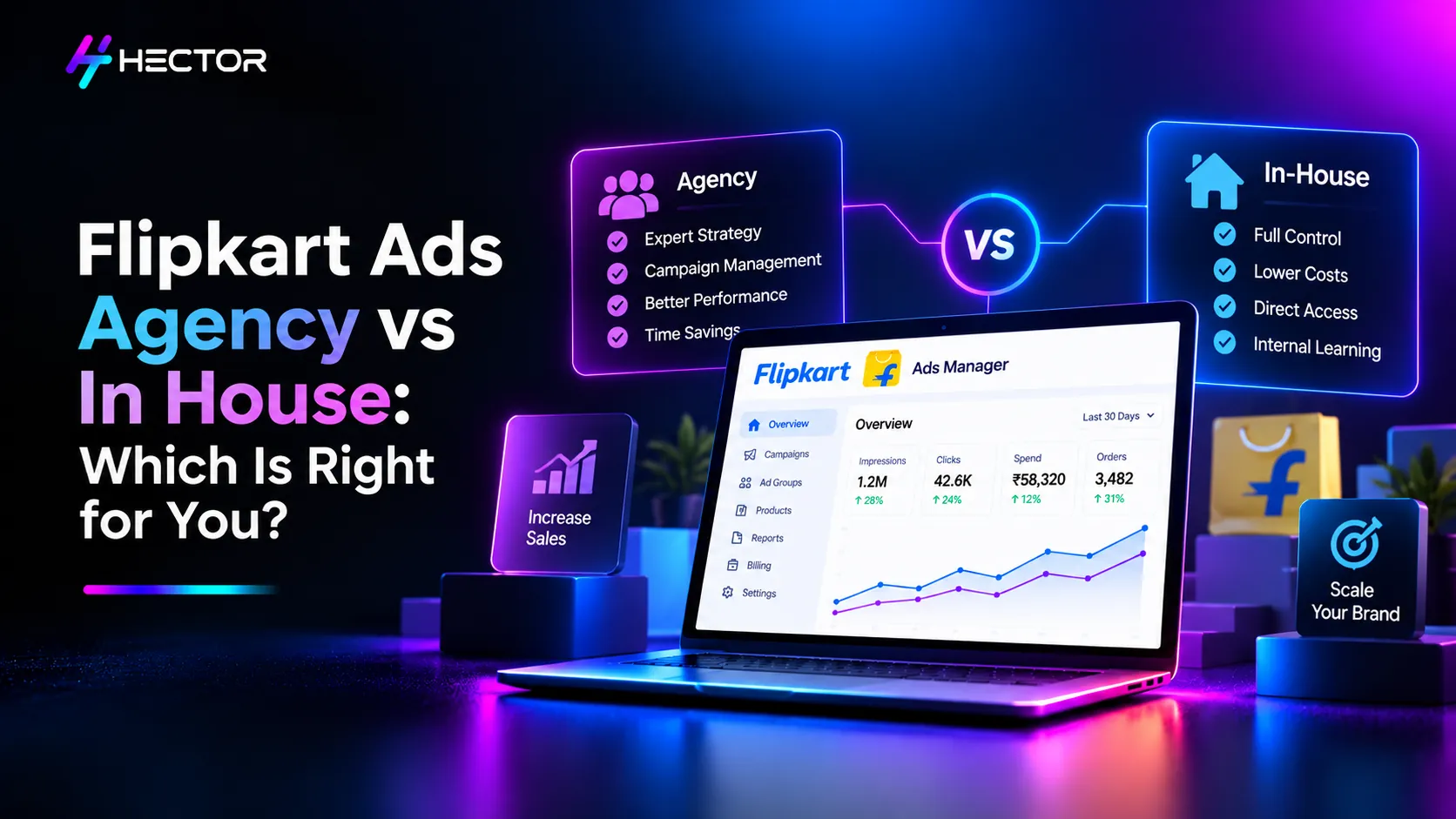
You start Flipkart ads yourself. One campaign for your top product. You learn quickly: the dashboard, the search-term report, and the bid mechanics. Sales pick up. You add a second campaign, then a third. Six months later, you have fourteen campaigns, eighty SKUs, four new product launches planned, and a Big Billion Days prep that needs to start next week.
You are also answering supplier calls, managing returns, reviewing listings, and handling three chat threads with your operations team. The last time you checked the search term report was eighteen days ago.
This is not a failure. This is what growth looks like. But it is also the exact moment when the in-house vs. agency question stops being theoretical and becomes urgent.
This guide gives you a clear, honest answer. Not which one is better in the abstract, but which one is right for you, at this stage of your business, with your current team and budget.
Why Scale Changes the Equation
Running three Flipkart campaigns with five products is a manageable weekend project. You can check bids on Monday morning, review the search term report mid-week, and make changes on Friday. The total time might be two hours a week. At that scale, self-management is clearly the right call; there is nothing complex enough to justify paying a third party.
But something changes as the account grows. Each new campaign brings new keywords to review, new search terms to harvest or block, new placement data to interpret, and new bids to adjust. The time requirement does not scale linearly; it scales faster. Going from five campaigns to fifteen does not triple the workload. The interdependencies between campaigns, the budget competition between them, and the growing surface area for things to drift unnoticed can make it feel like five times the work.
The festive season amplifies everything. Big Billion Days, Diwali Sale, and Republic Day Sale compress a month's worth of bidding decisions into 10 days, with CPCs spiking, competition intensifying, and inventory levels changing daily. Sellers who manage ads casually for the rest of the year often find that the festive window is when they lose the most money to underoptimised campaigns. If you also sell on Amazon, dayparting lets you run ads only during the hours or days that perform best.
The Time Reality of Managing 10-Plus Campaigns Manually
Effective Flipkart ad management at ten or more campaigns, across multiple product categories with active PLA and PCA, requires a consistent weekly routine: reviewing the search term report, adding negative keywords for non-converters, adjusting bids on over- and under-performing keywords, checking budget pacing, and reading placement-level performance data. Do this properly, and it takes five to eight hours a week for an experienced person. For someone still learning the platform, it takes longer.
That five to eight hours is the optimistic version, when everything is running normally. Launch a new product, enter a new category, or approach a sale period, and the time requirement spikes. If the person doing the ad management is also handling operations, supplier relationships, and customer service, something will get deprioritised. In most growing businesses, it is the search term report. Sellers who also advertise on Amazon can cut this repetitive work with Amazon PPC bulk operations, which update bids, keywords and budgets across many campaigns at once.
The Knowledge Gap That Builds Quietly
Self-managed ads on Flipkart start with the obvious optimisations: cutting keywords that never convert, bidding up on search terms that do, and checking which placements drive orders. Once those are done, the improvements become harder to find. Identifying why a campaign's ROAS dropped this week requires cross-referencing search term data, the placement report, the listing quality score, and, sometimes, a competitor's bidding behaviour. That kind of diagnosis requires experience across many accounts, not just yours.
An experienced Flipkart ads manager has seen the same patterns across dozens of accounts. They know that a sudden CPC spike in Home and Kitchen in October usually means a major seller is scaling ahead of the festive season. They know which category CPCs are seasonal and which signal actual competition changes. That cross-account pattern recognition is hard to build in a single seller account, no matter how attentive the management is.
What a Flipkart Ads Agency Actually Does
A Flipkart ads agency takes responsibility for your campaign performance. Not just setup, but ongoing management. Here is what that actually looks like in practice:
Full-service agencies also handle catalogue management, A+ content, and seller account operations. Many sellers choose to separate ad management from catalogue management, engaging a specialist ads agency for campaign work and handling the rest internally or with different vendors.
The Real Cost Comparison
The True Cost of In-House Management
In-house ad management is not free. Even if you are doing it yourself, there is a real cost: your time. If you spend six hours a week on Flipkart ads and your effective hourly value is Rs. 2,000 (a conservative figure for a founder or senior hire), that is Rs. 12,000 per week, or roughly Rs. 50,000 per month in founder time cost alone. If you hire a junior marketing executive to manage campaigns, you add their salary, their learning curve, and the cost of the tools they need.
The hidden costs of in-house management include third-party analytics tools (Rs. 5,000 to Rs. 15,000 per month, depending on the platform), the cost of suboptimal campaigns during the learning phase, and the opportunity cost of campaigns left under-monitised during busy periods. Platforms like Hector Ai provide consolidated Flipkart and Amazon analytics that reduce the tool cost while surfacing the actionable insights a lean in-house team needs to make better decisions faster. Sellers who also run Amazon campaigns can add Amazon PPC software that automates bids, budgets and placements to cut the manual hours further.
What Agencies Charge in India
Flipkart advertising agencies in India typically operate on two pricing models: a fixed monthly retainer or a performance-linked fee tied to ad spend or ROAS outcomes.
Before comparing agency fees to your current cost, first calculate your actual in-house cost, including founder time, tools, and the revenue impact of campaigns left unoptimized. The comparison often looks different from what the headline agency fee suggests.
When In-House Management Makes Sense
Self-management is the right call in more situations than sellers often give it credit for. The plumber analogy applies here: you fix a leaky tap yourself. You call a plumber when you do not know where to start, the problem is getting worse, or the risk of getting it wrong is too high. Flipkart ads are similar.
When an Agency Makes Sense
The Third Path: Flipkart's Saarthi Program
In August 2026, Flipkart launched a program that changes the in-house vs agency calculation for many sellers. Saarthi, named after the Sanskrit word for 'Charioteer', is Flipkart's Ads Partner Program that connects sellers with expert agency support from globally trusted consultancies, at zero cost to the seller.
Sellers are matched to agency partners based on their business stage, growth objectives, and advertising readiness. The program also includes an AI-powered campaign dashboard, built in collaboration with AtTheRate.ai, that gives sellers direct access to campaign intelligence tools and expert guidance.
For sellers who want agency-level expertise without the Rs. 25,000 to Rs. 75,000 monthly fee, Saarthi is the most significant development in Flipkart advertising since the platform introduced SmartROI. It removes the cost barrier that previously made agency support inaccessible to many small and mid-sized sellers.
Saarthi does not make the in-house vs agency decision irrelevant. Sellers still need to evaluate how much involvement they want in day-to-day decisions, how much transparency they require, and whether a full-service paid agency relationship might offer capabilities beyond what the Saarthi program provides. But it does create a meaningful middle ground that did not exist before August 2026.
Red Flags to Watch for When Hiring a Flipkart Ads Agency
Not every agency that says 'Flipkart ads' on their website is equipped to manage Flipkart ads well. Some are primarily Amazon-focused and have added Flipkart as an afterthought. Some cannot explain how the Flipkart auction works or what the difference between PLA and PCA is. Before you sign anything, watch for these signals:
-
They cannot name the five Flipkart ad formats: PLA, PCA, SmartROI, Display, and Brand Shelf. An agency that confuses PLA and PCA has not worked enough Flipkart accounts to understand the platform's fundamentals.
-
They promise specific ROAS targets without knowing your margins or category: No agency can guarantee outcomes without understanding your economics. A promised ROAS of 5x that ignores a 15% category CPC is not a guarantee; it is a pitch.
-
They will not give you case studies from your specific category: General case studies tell you little. An agency that has never managed campaigns in Home and Kitchen does not know that festive CPCs in that category spike differently from Fashion or Electronics.
-
They cannot clearly explain what happens to your account data when you stop working with them: Your campaign history, search term data, and performance reports are yours. Any agency that hedges on this question is at risk.
Five Questions to Ask Before You Sign
Before comparing agency fees to your current cost, first calculate your actual in-house cost, including founder time, tools, and the revenue impact of campaigns left unoptimized. The comparison often looks different from what the headline agency fee suggests.
Sellers are matched to agency partners based on their business stage, growth objectives, and advertising readiness. The program also includes an AI-powered campaign dashboard, built in collaboration with AtTheRate.ai, that gives sellers direct access to campaign intelligence tools and expert guidance.
They cannot name the five Flipkart ad formats: PLA, PCA, SmartROI, Display, and Brand Shelf. An agency that confuses PLA and PCA has not worked enough Flipkart accounts to understand the platform's fundamentals.
They promise specific ROAS targets without knowing your margins or category: No agency can guarantee outcomes without understanding your economics. A promised ROAS of 5x that ignores a 15% category CPC is not a guarantee; it is a pitch.
They will not give you case studies from your specific category: General case studies tell you little. An agency that has never managed campaigns in Home and Kitchen does not know that festive CPCs in that category spike differently from Fashion or Electronics.
They cannot clearly explain what happens to your account data when you stop working with them: Your campaign history, search term data, and performance reports are yours. Any agency that hedges on this question is at risk.