

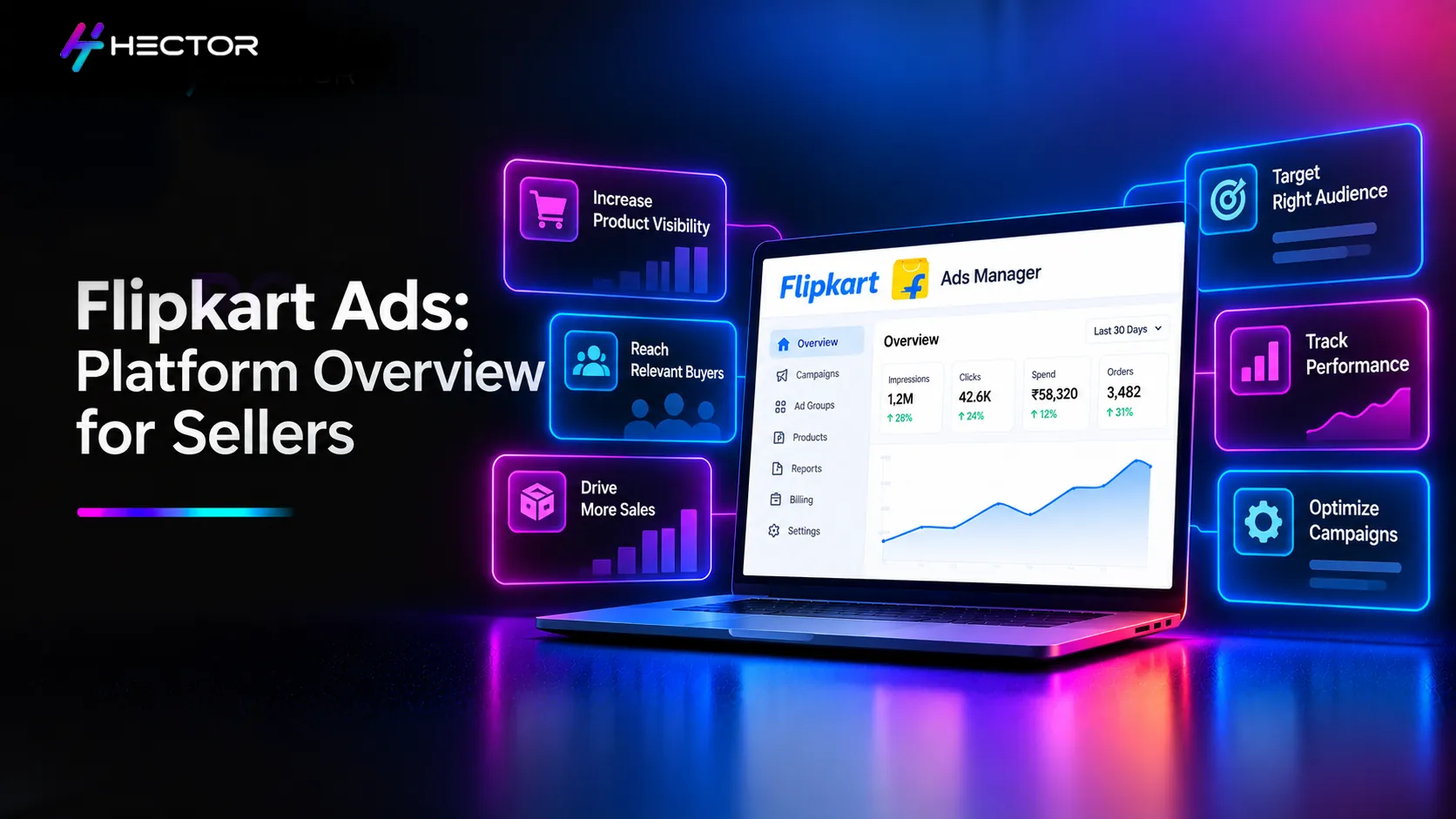
You have a product listed on Flipkart. The listing is live. The photos look good. The price is competitive. But when a shopper searches for exactly what you sell, your product does not appear on the first page of results. Maybe not even the second. Instead, you see twelve other products, all with a small grey 'Sponsored' tag next to their name, appearing right at the top of the results.
Those sellers did not have a better product. They did not have more reviews than you, at least not always. What they had was a running Flipkart Ads campaign.
Flipkart Ads is the platform's in-built system for paid product promotion. It is what sits between having a listing and having visibility. Once you understand how it works, the ad types, the auction, the costs, and the controls, the decision of whether and how to use it becomes a lot clearer.
This article covers the full picture: what Flipkart Ads is, the three formats it offers, how the auction works, and what it costs.
Flipkart Ads in One Paragraph
Flipkart Ads is the advertising section built directly into the Flipkart marketplace. It lets sellers and brands pay to appear in prominent positions, at the top of search results, in category browsing pages, and in recommendation sections across the Flipkart app and website. The platform uses a cost-per-click (CPC) model for most formats, meaning you pay only when a shopper actually clicks your sponsored listing, not simply for showing it. Campaigns are managed through the Ads tab in your Flipkart Seller Hub, and there is no minimum spend or monthly commitment.
Why Advertising on Flipkart Matters Now
Selling on Flipkart used to be simpler. You listed a product, optimised the title, added good images, and waited for organic search to bring buyers to you. That model still works to a degree. But the search results page has changed.
On Flipkart today, in competitive categories, the majority of the first page is paid placements. Organic listings do exist, but they are further down, and in crowded categories, they may start on the second or third scroll. The sellers appearing at the top are not necessarily ranking there organically. They are paying for those positions.
When more sellers enter every category, organic positions become harder to hold. Advertising on Flipkart is no longer just a way to grow faster; it is increasingly essential for a seller to maintain basic visibility while organic rankings mature. The good news is that the platform uses a CPC model, so you only pay when someone actually clicks. You are not paying for eyeballs you did not earn.
The Three Flipkart Ad Formats
Product Listing Ads (PLA), the Most Common Format
Product Listing Ads are the most widely used format on Flipkart, and the one most sellers encounter first. When a shopper types a search term into Flipkart, "running shoes for men" or "stainless steel water bottle," the first few results will often be PLAs. They look almost identical to organic results, carrying only a small 'Sponsored' label.
Think of it like the shelf at eye level in a supermarket. Brands pay retailers for eye-level slots because shoppers are most likely to pick from those positions. PLAs on Flipkart are the digital equivalent of premium placements in the most visible parts of search results, available to any seller willing to pay the per-click cost. Amazon sellers will recognise the same model in Amazon Sponsored Ads, which also charge per click.
SmartROI is an automated bidding campaign type available on the Flipkart Seller Ads platform. Advertisers set a target return on ad spend (ROAS), and Flipkart's system adjusts bids to work towards that target. SmartROI is not available on the newer Flipkart Ads platform. Before planning a SmartROI campaign, sellers should confirm which advertising account model they use. SmartROI may suit established products with consistent sales and conversion history. For products with limited performance data, advertisers should evaluate the available campaign options and gather sufficient data before scaling. Beyond search-based formats, Flipkart also offers display-style placements. Product Contextual Ads (PCA) appear in recommendation sections, related-product widgets, and browsing feeds rather than directly in search results. They use richer visual formats and reach shoppers who are browsing rather than actively searching. Brand Shelf is a format available to sellers enrolled in Flipkart's brand protection programme. It places a brand's entire product range in a dedicated shelf unit that appears prominently in category pages and search results, which is useful for building brand awareness rather than promoting a single product. When a shopper types a search term into Flipkart, the platform runs a real-time auction in milliseconds to decide which ads appear, where they appear, and at what cost. Every seller whose keywords match the search query automatically enters the auction. Think of it like a silent auction for a single advertising billboard in a busy location. Multiple advertisers want that billboard. Each one submits a bid for what they are willing to pay per click. The highest bidder wins the space. But Flipkart's auction has a twist: your bid is not the only thing that matters. The platform also considers your listing's quality score. The quality score is based on factors including your product's star rating, number of reviews, catalogue completeness (how detailed and accurate your listing is), images, and your historical conversion rate. A seller with a $1.20 bid and a strong quality score can outrank a seller with a $1.50 bid and a weak listing. This is important for two reasons: it keeps the auction fair for buyers (they see the best products, not just the highest bids), and it rewards sellers who have invested in their listing quality. Flipkart operates two advertising account models: Flipkart Seller Ads and the newer Flipkart Ads platform. These models differ in the campaign types available to sellers and brands. SmartROI is available on the Flipkart Seller Ads platform but is not available on the newer Flipkart Ads platform. Advertisers should identify which account model they use before selecting campaign types or planning their advertising strategy. Before launching a campaign, check the features and campaign options available in your advertising account to ensure they align with your campaign objectives. Flipkart PLA campaigns run on a dynamic CPC model. Your actual cost per click depends on your category, its competitiveness, and how your listing quality score compares to other advertisers in the same auction. As a broad guide for 2026: Rs. 1 to Rs. 3 per click: High-volume, well-supplied categories like electronics accessories, mobile accessories, and general fashion, where inventory is large, and competition normalises bids. Rs. 3 to Rs. 6 per click: Mid-competition categories including home furnishings, kitchenware, beauty basics, and fitness equipment. Rs. 6 to Rs. 10+ per click: High-competition categories and sale periods (Big Billion Days, Republic Day Sale) where many sellers increase bids simultaneously, pushing costs up. There is no fixed price and no guaranteed position. The cost varies auction by auction. Starting with a modest daily budget and testing before scaling is the recommended approach for any new advertiser. Flipkart Ads runs on a prepaid wallet model. Before your campaigns run, you load money into your advertising account balance. Your ads then draw from that balance as clicks occur. When the balance reaches zero, campaigns pause automatically until you top it up. Think of it like a prepaid mobile SIM card. You load a balance, use it for calls, and top up when it runs low. There is no monthly subscription, no credit arrangement, and no minimum commitment. You add what you want to spend, and you spend only what you loaded. This makes it easy to control maximum spend, especially when getting started.If you also advertise on Amazon, Amazon PPC Dayparting can schedule bids and budgets by the hour so a limited wallet goes further. There is a minimum daily budget per campaign, which varies by format. For PLA campaigns, the threshold is typically set low enough that most sellers easily meet it. Check the current minimum in your Seller Hub, as Flipkart occasionally updates these thresholds. Flipkart Ads is open to any active seller registered on the Flipkart marketplace. You do not need a brand registry, a minimum sales history, or a minimum account age to start with PLA campaigns. If you have live, in-stock listings and a Seller Hub account, you can create your first campaign today. Brand Shelf campaigns are limited to sellers enrolled in Flipkart's brand protection or brand registry programme, which requires documentation of brand ownership. If you have not registered your brand on Flipkart, PLA and SmartROI are the formats available to you. Individual sellers, small businesses, direct-to-consumer brands, and agencies managing accounts on behalf of sellers all access the same platform. If you are managing ads across Flipkart and other marketplaces like Amazon India or Meesho simultaneously, platforms like Hector Ai offer a unified dashboard that consolidates campaign performance from multiple marketplaces into a single view. On the Amazon side, Hector also offers Amazon Ads Optimization with rule-based automation for bids, budgets, and keyword harvesting. SmartROI Campaigns, Automation-First Bidding
Product Contextual Ads and Brand Shelf, Display, and Brand Formats
How the Flipkart Ad Auction Works
The practical implication is that improving your listing, adding more reviews, better images, and a more complete product description is not just an organic SEO play. It also makes every rupee of your ad spend more competitive.Understanding Flipkart's Two Advertising Account Models
What Flipkart Ads Actually Cost
The CPC Range by Category
The Prepaid Wallet Model
Who Can Use Flipkart Ads
What You Need Before Running Your First Ad