

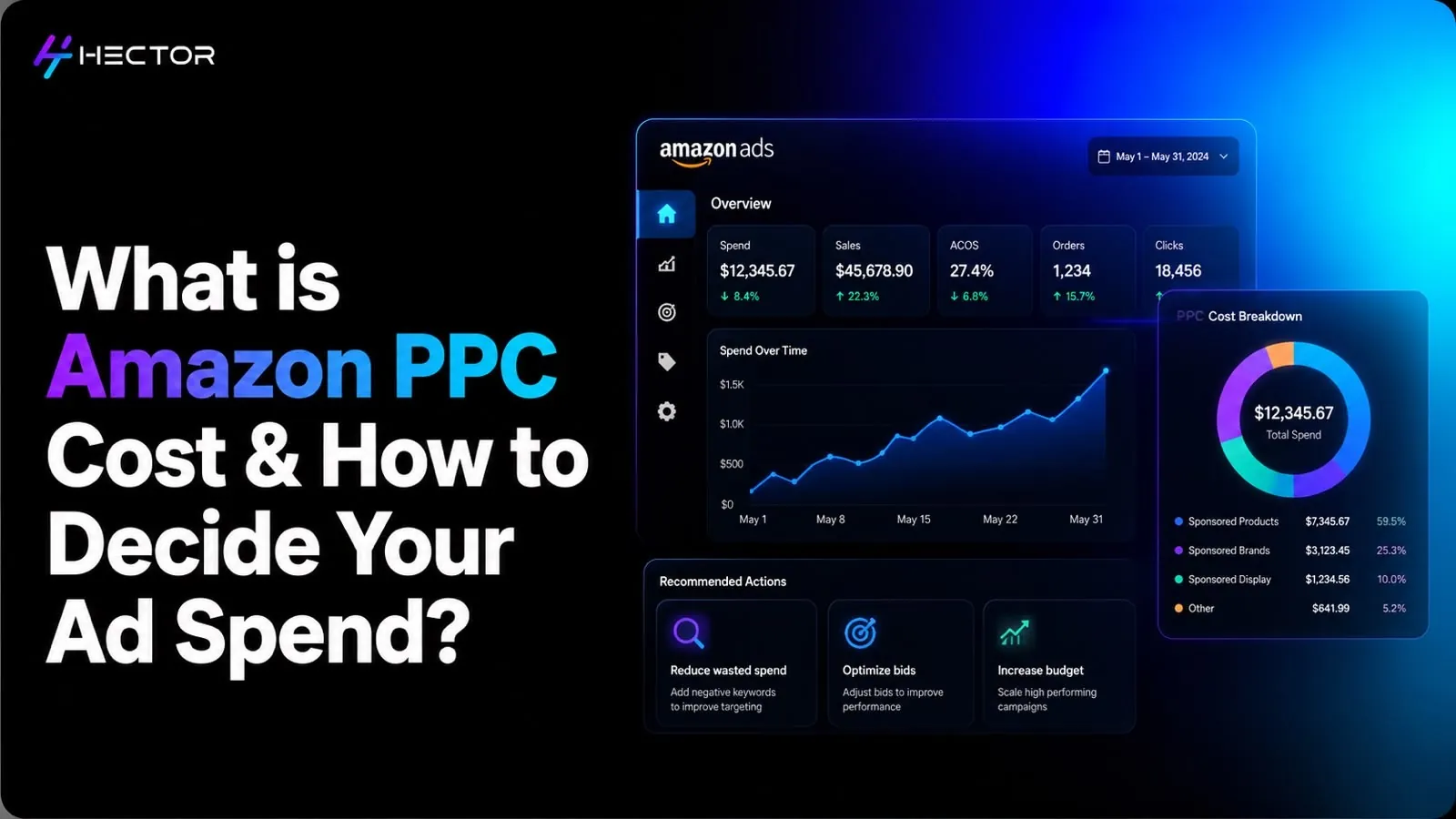
One of the first things a new seller does when they set up a Sponsored Products campaign is stare at the bid input field and wonder: what number do I put here? Too high and they blow the budget in two hours. Too low, and their ads never actually show. And somewhere in the middle is a number that gets them in front of shoppers without burning through margin, but nobody told them exactly what that number is or why it works.
Then the campaign runs. The spend looks reasonable on day one. By day five, there's a creeping feeling that something is off: the ACoS is higher than expected, clicks are coming in, but conversions are low, and the search term report shows that a meaningful chunk of the spend went to searches that had nothing to do with the product. The seller adjusts some bids, adds a few negative keywords, and moves on. Two weeks later, the same drift has happened again.
Amazon PPC cost is not a fixed number you set once and forget. It is the output of an auction system that runs every single time a shopper searches on Amazon: a system with specific mechanics, predictable inputs, and enough variables that understanding it properly makes a material difference to what you end up spending and what you get back from it.
This guide explains how Amazon decides what you pay per click, what drives that cost up or down, how to set a budget that makes sense for your margins, what actually wastes budget in the majority of campaigns, and why managing all of this manually stops working past a certain scale.
How Amazon PPC Pricing Actually Works
Pay-Per-Click, Not Pay-Per-Impression
Amazon PPC operates on a pay-per-click (CPC) model. Your ad can appear in search results, on product detail pages, or at the top of category pages, and Amazon charges you nothing for those appearances. You only pay when a shopper clicks on your ad.
This is different from some other advertising models (like CPM, where you pay per thousand impressions regardless of clicks), and it means your advertising cost has a direct relationship with engagement. Low click-through rates mean low spend. High click-through rates combined with poor conversion rates mean high spend with poor returns, which is why it's worth understanding the whole cost-to-conversion chain, not just the per-click cost.
The Second-Price Auction: What You Bid vs What You Pay
When a shopper runs a search on Amazon, an auction happens in milliseconds to determine which ads appear and in what order. Every seller whose campaign targets a keyword relevant to that search enters the auction with a maximum bid: the most they're willing to pay for one click from that search.
Here is the critical part most sellers miss: you almost never pay your maximum bid. Amazon uses a second-price auction model. If your ad wins the auction, the amount you pay per click is typically no more than your maximum bid and is often lower. Amazon determines your actual CPC using its dynamic auction system, which considers factors such as competing bids, ad relevance, and other auction signals. It should not be described as always being exactly $0.01 above the next highest bidder.
Ad Rank and Why Your Bid Alone Does Not Determine Placement
Winning placement in Amazon's Sponsored Ads auction depends on both your bid and Amazon's assessment of your ad's relevance and predicted performance. A higher bid alone does not guarantee the top placement. Amazon evaluates multiple signals to determine which ads are most likely to deliver a positive shopper experience before deciding placement and the final CPC. This means a well-optimised listing with a strong conversion rate history can win auction positions over a higher-bidding competitor with a less relevant product. Factors such as bid, ad relevance, and predicted performance work together to influence both ad placement and the final CPC.
This has a practical implication for advertising performance: improving your listing's overall quality—including factors that contribute to stronger shopper engagement and conversions—may improve your competitiveness in Amazon's ad auctions and lead to more efficient advertising over time. However, Amazon does not publicly disclose the exact relationship between a listing's conversion rate and the CPC advertisers ultimately pay. This is why listing quality and advertising performance are closely connected, even though the precise impact on CPC isn't publicly defined.
The Key Factors That Drive Your Amazon CPC Up or Down
Keyword Competition and Category CPCs
The single largest driver of CPC is how many other sellers are bidding on the same keyword. In categories with high competition: electronics, supplements, beauty, and home goods: CPCs are high because multiple well-funded sellers are fighting for the same search placements. In niche categories with fewer active advertisers, CPCs are low because there is less competition in the auction.
Within a single category, keyword specificity also matters. Broad, high-volume head terms like 'protein powder' attract more bidders and command higher CPCs than more specific long-tail terms like 'vegan vanilla protein powder 2lb'. The long-tail terms typically have lower search volume, but they also have lower CPCs and, often, higher conversion rates: because shoppers who search specific terms usually know exactly what they want.
Your Listing Quality and Conversion Rate
As explained in the auction mechanics section, Amazon considers your bid together with factors such as ad relevance and predicted performance when determining ad placement. However, Amazon does not publicly disclose the specific factors it uses or how they are weighted. A listing with strong images, clear copy, competitive pricing, and a healthy review count is more likely to provide a better shopper experience, which can contribute to stronger advertising performance over time.
Conversely, a listing with poor images, thin bullet points, or below-average ratings will convert at a lower rate. Amazon's system will deprioritise it in the auction, or require you to bid significantly higher to achieve comparable placement, because it predicts fewer purchases per impression. Listing quality and advertising cost are directly connected.
Match Type and Targeting Precision
Amazon Sponsored Products offers three keyword match types: exact, phrase, and broad. Each targets a different range of searches:
• Exact match: your ad shows when a shopper searches for your keyword or a close variation. It typically delivers the most targeted traffic and can improve relevance, although CPC varies depending on keyword competition, shopper intent, and Amazon's auction dynamics.
• Phrase match: your ad shows when a shopper's search contains your keyword as a phrase, with words before or after it. Moderate reach and relevance.
• Broad match: your ad shows for searches that include your keyword and other related queries that Amazon considers relevant. It typically provides the widest reach and can generate more irrelevant traffic than a phrase or exact match. However, its CPC is not universally higher than other match types and varies depending on competition, keyword intent, and auction dynamics.
Auto campaigns, which let Amazon choose what searches your ads appear for, function similarly to broad match in terms of range but have no direct bid-per-keyword control. They are valuable for keyword discovery but need an active search term report review and negative keyword management to prevent budget drift.
Placement: Top of Search vs Product Pages
Where your ad appears affects how much you pay and how it performs. Amazon's placement multiplier system allows you to bid more aggressively (or less) for specific placements:
• Top of Search (first page): highest visibility and often higher click-through rates than other placements. Amazon allows advertisers to apply placement bid adjustments for Top of Search, which can significantly increase CPC. However, the actual increase varies depending on the keyword, competition, category, bidding strategy, and auction dynamics.
• Rest of Search: placements further down search results pages. Lower CPC, lower CTR, lower conversion rate.
• Product Pages: ads appearing on competitor product detail pages and category listing pages. CPC is generally lower than top-of-search, but conversion intent varies widely depending on the product page where your ad appears.
Amazon PPC Cost Benchmarks by Category
What Average CPCs Look Like Across Major Categories
These benchmarks reflect typical ranges drawn from Jungle Scout CPC data (2025) and industry pattern analysis. Your actual CPC will depend on the specific keywords you're targeting, the time of year, and the competitive activity in your exact niche: not just the broad category.
Why CPC Can Vary 10x Within the Same Category
Looking at the Supplements category: a seller advertising a 'vitamin C supplement' might pay $2.50 per click. A seller advertising 'vitamin C with rosehip 1000mg 180 tablets' on an exact-match keyword might pay $0.35. Same category. Same product type. Dramatically different CPC.
The difference is the competition density on the specific keyword. The generic term attracts every supplement brand. The specific term attracts only sellers who offer that exact formulation. As a general rule, longer, more specific keywords cost less and convert better, because the shopper who searches them has already narrowed their decision and is closer to buying.
Setting Your Amazon PPC Budget: The Right Starting Framework
Daily Budget vs Campaign Budget: How Amazon Paces Spending
Amazon uses your daily budget as a guideline for how much a campaign is expected to spend each day. Campaigns generally stop serving ads once the daily budget is exhausted. However, Amazon may occasionally exceed the daily budget on a given day while keeping total monthly spend within the campaign's budget limits. As a result, under-budgeted campaigns may still miss opportunities to reach high-intent shoppers later in the day.
This creates a practical problem for under-budgeted campaigns. A campaign with a $5 daily budget targeting a $1.20 average CPC can only generate roughly 4 clicks per day before it exhausts its budget. Those 4 clicks might happen in the first two hours of the morning. For much of the remainder of the day, your campaign may no longer serve ads consistently, reducing visibility during periods when shoppers are still actively searching.
How to Calculate a Starting Budget From Your Margins
The most disciplined way to set a budget is to work backward from your unit economics. If your product sells for $30 and your contribution margin after accounting for variable costs (such as COGS, fulfillment fees, and other selling expenses) is 40%, your margin per unit is $12. If you're willing to spend 20% of revenue on advertising, your target ad cost per sale is $6. If your conversion rate is around 10% (a reasonable baseline in most categories), you need approximately 10 clicks to generate one sale, which means your maximum CPC is $0.60 to stay within target.
This calculation gives you a maximum CPC ceiling: the bid above which advertising becomes unprofitable for you, regardless of how much traffic it drives. Setting bids above this ceiling is only worth doing temporarily to build reviews and velocity on a new product, where the long-term rank benefit justifies short-term advertising losses.
The ACoS and ROAS Connection to Budget Decisions
ACoS (Advertising Cost of Sales) is your advertising spend divided by the revenue your ads generated, expressed as a percentage. ROAS (Return on Ad Spend) is the inverse: revenue divided by advertising spend. They measure the same thing from different directions.
Break-even ACoS is commonly estimated using your contribution margin after accounting for variable costs, rather than gross margin alone. While gross margin can provide a useful starting point, it may not accurately represent break-even profitability because it doesn't include all variable expenses associated with each sale. Understanding your contribution margin provides a more realistic estimate of the maximum advertising cost your business can sustain while remaining profitable. Brands using Amazon Marketing Cloud can go further, analysing cross-campaign attribution data to understand exactly which keywords and formats are driving the most profitable outcomes.
Budget decisions become clearer once you've established this threshold, as it helps guide sustainable advertising spend. However, exceeding your estimated break-even ACoS doesn't always mean a campaign is unsuccessful. Businesses may intentionally accept a higher ACoS during product launches, customer acquisition efforts, or ranking campaigns when long-term growth objectives justify lower short-term profitability.
What Actually Wastes Your PPC Budget: And How to Stop It
Irrelevant Search Terms and the 23% Drain
The most consistent source of wasted Amazon PPC spend is advertising showing against search queries that don't match what you're selling. Auto campaigns and broad-match keywords are designed to cast wide nets, and they do. The consequence is that a portion of every campaign's budget goes to shoppers who searched for something different from what you offer.
In Hector AI's account analysis, campaigns without a structured negative keyword strategy spent an average of 23% of their daily advertising budget on irrelevant or low-performing clicks during the first 30 days. On a $100/day campaign, that's $23/day: $690/month: going to searches that were never going to convert. The fix is a methodical search term report review and regular negative keyword addition, which prevents the same irrelevant terms from consuming budget week after week. Brands scaling beyond Sponsored Products can extend this efficiency into Amazon DSP, where programmatic audience exclusions work the same way negative keywords do in search.
Overbidding on Broad Match Keywords
Broad match keywords are the most likely to generate irrelevant traffic, and sellers frequently overbid on them because the suggested bid Amazon shows in Campaign Manager reflects average competition across all queries that match the broad term, not just the relevant ones. A high suggested bid on 'protein powder' reflects competitive pressure from every formulation, brand, and product type in the category. If you only sell one type of protein powder, paying at the top-of-market bid for a broad keyword means paying premium prices for a lot of traffic that would never buy your specific product.
The discipline is to start broad match campaigns at bids meaningfully below the suggested bid, harvest the converting search terms into exact-match campaigns at appropriate bids, and negate the non-converting terms. This is the standard account structure that keeps broad match useful for discovery without letting it become an unmanaged drain on the budget.
Running Ads on Listings That Do Not Convert
The most expensive mistake in Amazon PPC is running aggressive advertising on a listing that converts poorly. If your conversion rate is significantly below that of comparable products in your category, it's worth improving your listing before increasing advertising spend. Advertising drives more traffic to your existing listing, so its effectiveness depends heavily on how well that listing converts visitors into customers. Strengthening your listing before scaling ad spend can improve overall advertising efficiency.
Before increasing advertising spend on any product, review your listing's conversion rate (found in Business Reports in Seller Central as "Unit Session Percentage") alongside the performance of comparable products in your category, where relevant. If your conversion rate is significantly below that of comparable products, consider improving elements such as images, pricing, product copy, and reviews before increasing advertising spend. Optimizing the listing often improves the effectiveness of your campaigns.
Why Manual Bid Management Breaks Down at Scale
The Lag Problem: Bids Set Weekly vs a Market That Moves Daily
Amazon's auction is not static. Competitor bids change. Seasonal trends shift. New entrants enter categories. A keyword that was correctly priced on Monday can be significantly overbid by Thursday if a competitor pulls back their spend, or underbid if a major seller enters the auction. Manual bid review, even on a weekly cadence, will always be working with data that is already 7 days stale.
At a small scale: 3 campaigns, 150 keywords: a weekly review is manageable, and the lag cost is acceptable. At scale: 20 campaigns, 800 keywords: weekly review means hundreds of bid decisions that are always running behind the market. Underperforming keywords continue draining budget. Profitable keywords that could capture more volume stay under-invested. The portfolio as a whole underperforms relative to what automated management on the same data would produce.
How Automated Bid Rules Close the Gap
Automated bid rules define the conditions under which a bid changes, and run those conditions against your actual performance data continuously, not once a week. A rule that says "if ACoS exceeds 40% over the past 14 days, reduce bid by 12%" runs that analysis every day across every keyword in the campaign. A rule that says "if ACoS is below 20% and impressions have declined week-over-week, increase bid by 10%" captures the opportunity of an underinvested profitable keyword without waiting for a manual review.