

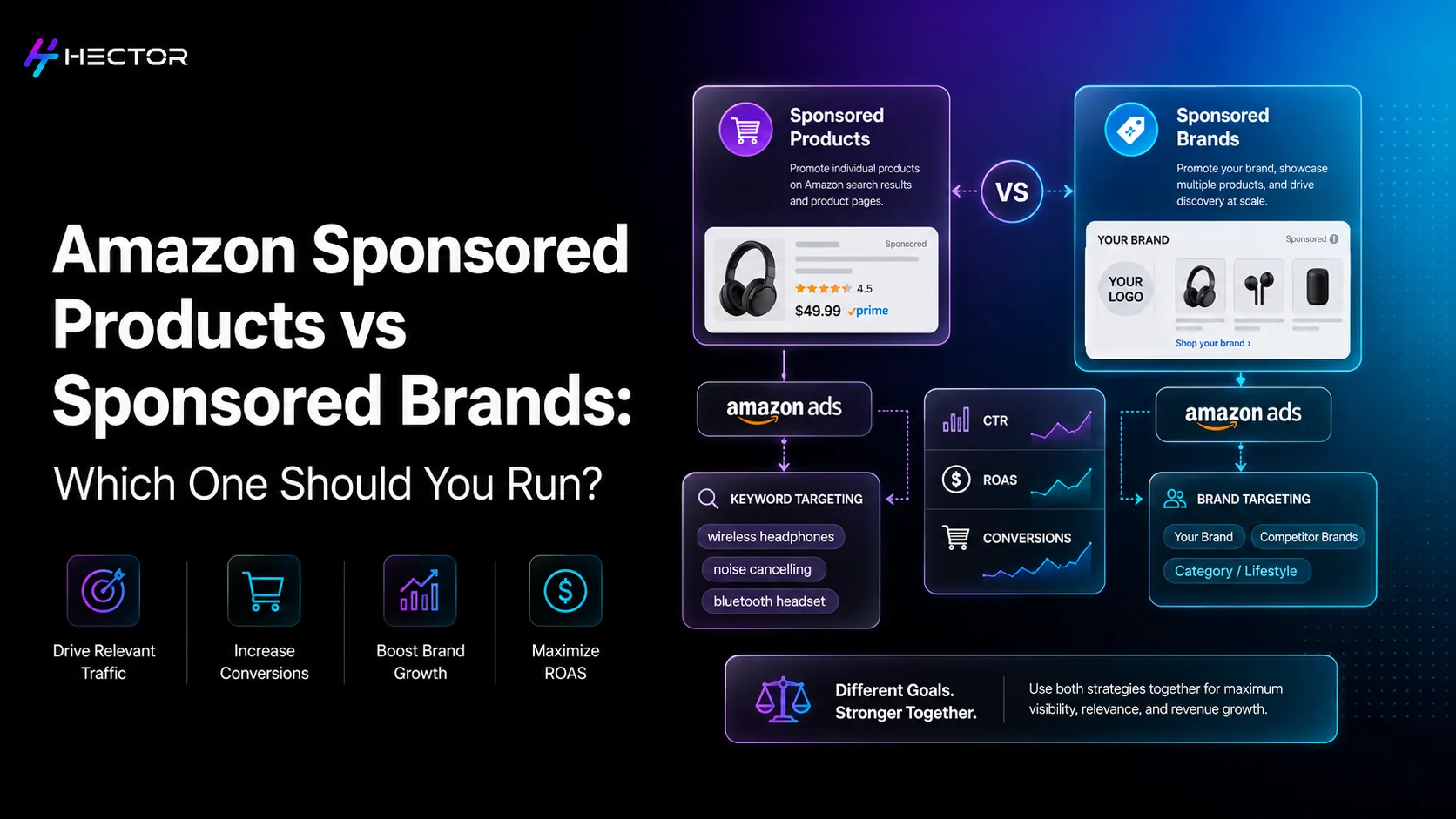
Search for anything on Amazon: kitchenware, supplements, tech accessories, and look at the first page of results carefully. Before the organic listings, usually before anything else, there's a banner: a brand logo, a short headline, and three products laid out side by side. That's a Sponsored Brands ad. Below it, woven into the organic results, are other ads with an orange 'Sponsored' label on individual products. Those are Sponsored Products. Two Amazon Sponsored Ads formats. Same search results page. Different jobs. Most sellers start with Sponsored Products and stay there: not because Sponsored Brands isn't worth running, but because nobody clearly explained what each one actually does, when to use them together, and what happens to your advertising performance when you do. The question 'Sponsored Products vs Sponsored Brands: which is better?' frames them as a choice when the answer for any established brand is: both, in the right order, for different reasons. In Hector AI's analysis of 2,400+ brand accounts in 2025, brands running both Sponsored Products and Sponsored Brands on the same keyword sets generated 41% higher ROAS over 90 days compared to brands running Sponsored Products alone (Hector AI Internal Data, 2025). The performance gap isn't about spending more: it's about owning more of the search results page when your buyers are ready to buy. This guide covers what each format does, where it appears, how they compare across every relevant dimension, when to add Sponsored Brands to an existing SP strategy, and why managing both at scale requires a different approach to campaign management. The clearest way to understand the difference is to ask: what does each format capture? Sponsored Products captures explicit product intent. A shopper searching for 'stainless steel French press' with their wallet open. Your ad intercepts that intent and converts it to a sale. The relationship is direct: search term → click → product page → purchase. Sponsored Brands captures brand consideration. A shopper browsing the category who hasn't committed to a specific product. Your banner at the top of the results introduces your brand: name, identity, range, before they make a decision. It shapes the consideration set before the conversion happens. Neither format is superior. They operate at different stages of the same buyer journey. That's why running both: for the right seller, at the right time, compounds rather than duplicates. Sponsored Products appear in three primary locations: Amazon search results: Displayed alongside organic listings with a "Sponsored" label and may appear in top, middle, or bottom search placements. Product detail pages: Featured in sponsored product placements on relevant product pages, including competitor listings where applicable. Select off-Amazon premium apps and websites: Eligible campaigns may also serve ads beyond Amazon on participating premium apps and websites, depending on campaign settings and marketplace availability. Sponsored Brands support multiple creative formats that help showcase your brand in different ways, depending on marketplace availability and campaign eligibility. These include: Product Collection: Displays your brand logo, custom headline, and featured products to drive shoppers to a product detail page or Brand Store. Store Spotlight: Highlights multiple pages from your Amazon Brand Store, helping shoppers explore different product categories. Sponsored Brands Video: Uses autoplay video creatives within shopping results to showcase a product and attract shopper attention. Other supported creative variations: Additional Sponsored Brands formats and placements may be available depending on the marketplace, campaign type, and Amazon's current advertising features. Sponsored Products are available to eligible sellers, vendors, book vendors, Kindle Direct Publishing (KDP) authors, app developers, and agencies with eligible products and active Amazon advertising accounts. Brand Registry is not required to run Sponsored Products, although advertisers must meet Amazon's eligibility requirements for Sponsored Ads. Sponsored Brands are generally available to advertisers with Amazon Brand Registry or other eligible brand or author access, depending on the advertiser type and marketplace. Eligibility requirements may vary across Amazon marketplaces, so advertisers should confirm the current requirements for their region before launching Sponsored Brands campaigns. Both formats use CPC (cost-per-click): you pay only when a shopper clicks your ad. There is no impression-based charge for standard Sponsored Products or Sponsored Brands campaigns. Sponsored Brands CPCs may be higher or lower than Sponsored Products CPCs depending on factors such as product category, keyword competition, ad placement, marketplace, and bidding strategy. Because the two formats serve different objectives and placements, CPCs should be evaluated in the context of overall campaign goals, conversion performance, and return on ad spend rather than as a fixed benchmark. Sponsored Products: keyword targeting (exact, phrase, broad match) and product/ASIN targeting. Auto campaigns are available: a critical difference that makes SP the better discovery and keyword research tool of the two formats. Sponsored Brands support multiple targeting options depending on the campaign type and marketplace, including keyword targeting (exact, phrase, and broad match), category targeting, and product targeting. Sponsored Brands do not support automatic targeting, so advertisers typically rely on keyword research and campaign performance data to build effective campaigns. Using Sponsored Products automatic campaigns to identify high-performing search terms before launching Sponsored Brands remains a common and effective strategy. Sponsored Products: ACoS (Advertising Cost of Sales): ad spend as a percentage of attributed revenue. This measures the direct efficiency of your advertising investment. Sponsored Brands should be evaluated using a combination of metrics based on the campaign objective, including Advertising Cost of Sales (ACoS), Return on Ad Spend (ROAS), click-through rate (CTR), cost per click (CPC), attributed sales, conversions, and New-to-Brand (NTB) metrics where available. Amazon reports ACoS for both Sponsored Products and Sponsored Brands campaigns. New-to-Brand metrics provide additional insight into how effectively Sponsored Brands campaigns are attracting first-time customers, making them especially valuable for brand growth objectives. For most advertisers, Sponsored Products are the best place to start because they help generate conversion data, identify high-performing keywords, and establish campaign performance before expanding into additional ad formats. However, advertisers with Amazon Brand Registry and well-developed brand assets may also choose to test Sponsored Brands early to increase visibility, strengthen brand presence, and support broader marketing objectives. The right sequencing depends on your business goals, account maturity, and available creative assets. Launching Sponsored Brands without profitable Sponsored Products is spending on brand visibility for a brand that hasn't yet proven its conversion ability. The SP foundation also builds the sales velocity and review history that make your Sponsored Brands ads credible: a brand with 5 reviews on its featured products doesn't get the same conversion lift from brand visibility as one with 250 reviews. When a shopper searches for a keyword you're targeting with both Sponsored Products and Sponsored Brands, your brand occupies two distinct positions on the search results page simultaneously: • Top of the page: Sponsored Brands banner with your logo, headline, and three products • Within search results: your Sponsored Products ad appears among organic listings This dual presence creates a brand halo effect: a compound advertising signal that changes shopper perception in a way neither format achieves alone. When a shopper sees your brand at the top of a search result and then encounters your products again in the listings, your brand feels more established, more dominant in the category, and more credible. You haven't changed your products or your reviews. You've changed the proportion of the shopper's search experience that your brand owns. The 41% ROAS lift in brands running both formats comes primarily from two mechanisms: better conversion rates on existing buyer traffic (brand recognition reduces purchase hesitation), and acquisition of new customers who wouldn't have converted on SP alone. New-to-Brand (NTB) metrics help advertisers understand how effectively Sponsored Brands campaigns attract first-time customers. However, NTB rates vary widely depending on factors such as product category, brand maturity, targeting strategy, audience, and campaign objectives. Rather than relying on a universal benchmark, advertisers should use NTB as a directional metric alongside ACoS, ROAS, sales, and other performance indicators to evaluate campaign success over time. Running Sponsored Products alone creates a campaign management workload. Adding Sponsored Brands doesn't double the workload: it creates a qualitatively different management challenge that a weekly manual review can't handle well. When you run both SP and SB on overlapping keyword sets, you have two separate bid levels per keyword: what you're bidding in SP and what you're bidding in SB. These bids interact in the auction: if you're the high bidder in both formats for the same keyword, you're paying a premium for both placements simultaneously. If your SB bid is too low, you lose the top-of-search position to a competitor, negating the dual-presence advantage. The optimal bid in each format isn't the same: SB CPCs run higher, SB clicks convert differently, and SB's new-to-brand goal means the acceptable ACoS threshold may be different from your SP target. Manually managing bid levels across both formats, for the same keyword set, on a weekly review cycle means you're always working with data that's already 7 days stale. Automated bid rules for multi-format strategies define the conditions and actions for each format independently, but with awareness of the overall system: • SP bid rules: if keyword ACoS exceeds target threshold → reduce bid by defined percentage; if keyword ROAS exceeds target → increase bid; if search term converts in auto campaign → harvest to exact-match manual at calibrated bid • SB bid rules: if top-of-search impression share falls below target → increase bid on branded and category keywords; if NTB rate drops below 50% →, investigate audience overlap with SP campaigns; if SB ACoS exceeds ceiling → reduce bids on low-converting terms These rules run daily across every keyword in both format stacks: not once a week when a human opens a spreadsheet. In Hector AI's account analysis, automated bid rules across Sponsored Products campaigns reduced average CPC by 18% compared to manually managed campaigns over the same 90-day period (Hector AI Internal Data, Jan–Dec 2025). The same logic applied to multi-format management eliminates the bid cannibalism, lag, and drift that manual processes introduce. Building Your Combined Sponsored Products and Sponsored Brands Strategy The most effective multi-format campaign structure uses SP as the foundation and SB as the amplifier: • Sponsored Products (auto): keyword discovery and search term mining. Runs continuously to surface, converting search terms from real buyer behaviour. • Sponsored Products (manual exact-match): proven keywords at precise bids. Populated from auto campaign harvest. This is your core SP performance engine. • Sponsored Brands (headline): your top-converting SP keywords as SB targets. Same keywords, but buying top-of-search real estate to own the full search page. • Sponsored Brands Video: for keywords where video can demonstrate product benefit. Particularly effective for categories where product use is the key purchase driver (fitness, kitchen, outdoor). For brands new to the combined approach, a reasonable starting allocation is 80% Sponsored Products / 20% Sponsored Brands. SP should always hold the majority share because it directly generates the conversion data that feeds the SB keyword strategy and because SP attribution is cleaner and faster: easier to optimise. As SB's new-to-brand data accumulates and NTB customers demonstrate repeat purchase behaviour, the case for shifting budget toward SB strengthens. Brands looking to scale beyond search can complement this stack with Amazon DSP to reach high-intent audiences across Amazon-owned and third-party inventory. Brands in high-NTB categories (beauty, supplements, apparel) often shift toward 65/35 or 60/40 allocation over time as the lifetime value of SB-acquired customers justifies the higher CPC.What Sponsored Products and Sponsored Brands Actually Are
Sponsored Products: The Demand-Capture Format
Sponsored Brands: The Brand-Presence Format
The One Job Each Format Is Built For
Where Each Ad Type Actually Appears on Amazon
Sponsored Products Placements
Sponsored Brands Placements and Formats
The Full Head-to-Head Comparison
Eligibility Requirements
Cost and Bidding Model
Targeting Options
Primary Metric and What It Measures
The Sequencing Decision: When to Add Sponsored Brands
Sponsored Products Are Usually the Best Starting Point
The Four Signals That Tell You Sponsored Brands Are Ready
The Brand Halo Effect: Why Running Both Amplifies Performance
What Happens When Both Formats Appear for the Same Search
New-to-Brand Rate and Why Sponsored Brands Moves It
Why Manual Management Breaks When Running Both Formats
The Bid Management Complexity That Doubles With a Second Format
How Automated Bid Rules Handle Multi-Format Campaigns
The Campaign Structure That Makes Both Formats Work Together
Budget Allocation Between Formats
Measuring Performance Across the Combined Stack
Amazon Sponsored Products vs Sponsored Brands: Which One Should You Run?
Frequently Asked Question
Sponsored Brands are generally available to advertisers enrolled in Amazon Brand Registry or those with other eligible brand or author access, depending on the advertiser type and marketplace. Eligibility requirements can vary across regions, so it's best to verify the latest requirements for your specific marketplace before launching Sponsored Brands campaigns. If Sponsored Brands aren't yet available for your account, Sponsored Products remain an effective way to build campaign data and establish your advertising foundation.
Sponsored Brands typically carry higher CPCs than Sponsored Products for equivalent keywords: usually 15–40% higher, depending on category and competition level. The premium reflects the placement advantage: top-of-search real estate commands higher auction prices. Sponsored Brands can generate strong visibility and engagement because of their prominent creative placements. However, click-through rates vary depending on factors such as ad format, creative quality, product category, keyword targeting, marketplace, and competitive landscape. Performance should be evaluated using campaign-specific data rather than assumed benchmarks. The correct comparison is not CPC but cost-per-acquired-customer over 90 days, accounting for repeat purchase behaviour. At this point, SB's economics often compare favourably to SP for brand-building objectives.
Yes, and for your top-performing keywords, you should. Running both formats on the same high-converting search terms creates the dual-presence effect: your brand appears both at the top of the page (SB) and within search results (SP), which drives the brand halo effect and the 41% ROAS lift observed in Hector AI's multi-format account analysis. The concern about bid inflation (both formats bidding on the same keyword, driving up your own costs) is real but manageable through bid rules that coordinate the two formats. Don't withhold your best keywords from SB out of concern about overlap: the visibility advantage of dual presence typically outweighs the bid friction.
Sponsored Brands Video is a Sponsored Brands format that places an auto-playing video ad in the middle of Amazon search results, distinct from the standard top-of-search banner placement. It requires a video asset (15–45 seconds is the standard range) and Brand Registry. In categories where product demonstration improves purchase confidence: fitness equipment, kitchen appliances, skincare, and outdoor gear. Video can improve shopper engagement in many categories, but performance varies depending on factors such as creative quality, product category, keyword targeting, audience relevance, and ad placement. For sellers with video content available, Sponsored Brands video is worth testing alongside standard Sponsored Brands campaigns to understand its impact on campaign performance. For advertisers without video assets, standard Sponsored Brands campaigns can still be effective. However, results will depend on factors such as creative quality, keyword strategy, product category, audience relevance, and overall campaign objectives.
The primary indicator is the new-to-brand (NTB) rate: the percentage of SB conversions from shoppers who haven't purchased your brand on Amazon in the past 12 months. A healthy NTB rate for SB is 60–80%. If your SB campaigns show NTB rates below 40%, your ads are largely converting existing customers who would have purchased anyway: meaning SB is not doing the brand-acquisition job it's built for. Secondary indicators: branded search volume trends (are more shoppers searching your brand name directly over time?), and the combined SP + SB ROAS compared to your SP-only baseline. If the combined ROAS exceeds what SP was generating before you added SB, the investment is compound-positive.