

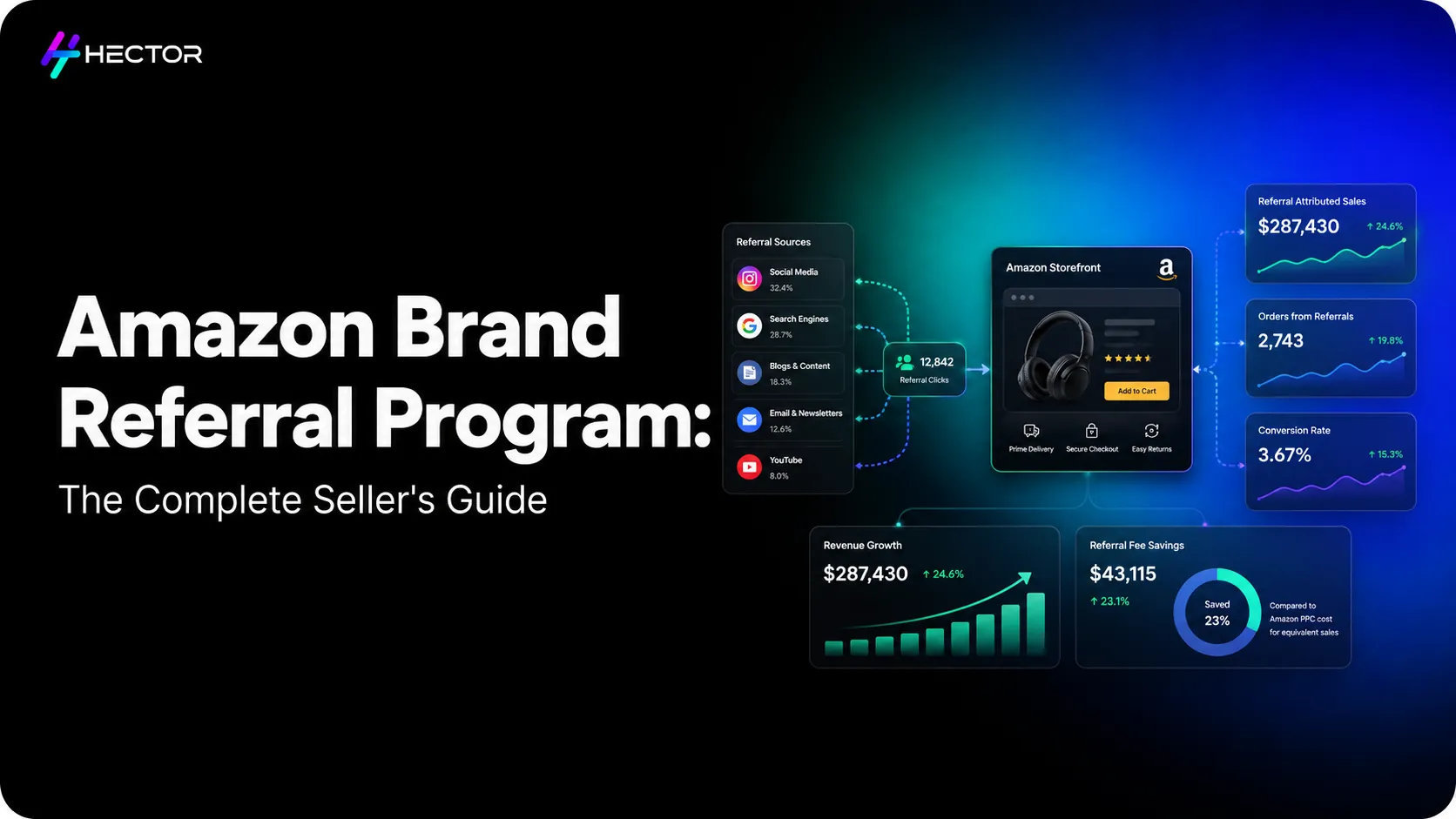
Most Amazon sellers think about traffic in one direction: Amazon's algorithm sends shoppers to their listing, their ads capture the ones who search for their keywords, and that's the game.
But what if Amazon paid you to bring traffic from outside the platform? Not just allowed it, actually rewarded you with a financial bonus every time someone you drove from Instagram, Google, TikTok, or email converted into a sale?
That's exactly what the Amazon Brand Referral Program does. And a surprisingly large number of Brand Registry sellers have never touched it.
The Brand Referral Bonus program is available to eligible Brand Registry sellers who use Amazon Attribution to measure qualifying off-Amazon traffic that results in attributed Amazon sales. That bonus is applied as a credit against future referral fees. In practice, a brand running Meta ads to an Amazon listing can reduce the effective cost of selling on Amazon, turning a marketing expense into a fee offset.
In Hector AI's analysis of 380 brand accounts across Q2–Q4 2025, brands using Amazon Attribution tags alongside structured external traffic campaigns reduced their effective net referral fees by an average of 9.4%. Based on Hector AI's internal analysis. Methodology available on request. Based on Hector AI's internal analysis. Methodology available on request. Meaningfully improving their unit economics without changing their product price or adjusting their Amazon advertising bids (Hector AI Internal Data, 2025).
This guide covers everything: what the programme is, who qualifies, how the bonus is calculated, how to set it up, which external channels work best, and how to combine it intelligently with your existing Amazon advertising strategy.
What the Amazon Brand Referral Bonus Program Is and How It Works
Definition: The Bonus in Plain English
Here is the mechanic in the simplest possible terms:
• You create a special tracking link through Amazon Attribution for a product you're advertising externally
• You use that link in your Meta ad, Google ad, TikTok video, email, or influencer post
• A shopper clicks the link, arrives on your Amazon product detail page, and makes a purchase
• Amazon detects that the sale came via your external attribution tag
• Amazon credits your account with a Brand Referral Bonus based on the applicable rate for your product category and marketplace.
• The bonus is typically applied as a credit against future referral fee charges in subsequent settlement cycles.
The bonus is not instant, and it's not cash. It's a referral fee credit that Amazon applies automatically to your next eligible referral fee charge. Over a month of consistent external traffic, these credits accumulate into meaningful cost reductions.
How the Brand Referral Bonus Differs from a Standard Referral Fee Reduction
Amazon's standard referral fees, the commission Amazon charges on every sale, are fixed by product category and cannot be negotiated. They typically range from 8% to 17% of the sale price.
The Brand Referral Bonus does not reduce the referral fee directly. Instead, it creates an offsetting credit that is applied against your future referral fee charges. If your standard referral fee is 15% and your Brand Referral Bonus generates a 10% credit on an equivalent sale value, your net referral fee cost is effectively 5% lower on that volume.
Eligibility, Who Qualifies and Who Doesn't
Brand Registry Requirement and Why It Exists
The Brand Referral Bonus program is available to eligible sellers enrolled in Amazon Brand Registry who use Amazon Attribution to track qualifying off-Amazon traffic and attributed sales. Amazon's programme for brand owners with registered trademarks. This requirement exists because the programme is designed to incentivise brands to invest in building external marketing infrastructure, which Amazon treats as a signal of brand seriousness and a driver of new customer acquisition to the platform.
If you're not yet enrolled in Brand Registry, eligibility requirements generally include ownership of an eligible trademark and successful completion of Amazon's Brand Registry verification process, which may vary by marketplace. Brand Registry approval timelines vary depending on trademark status, marketplace, and Amazon's verification requirements. The Brand Referral Program's potential value, particularly for brands already spending on external marketing, is often cited as one of the clearest ROI justifications for pursuing Brand Registry.
Product Category Eligibility
Eligibility for the Brand Referral Bonus varies by product category, marketplace, and Amazon's current programme terms. Amazon determines eligible and excluded products under its current programme terms. Eligibility and exclusions may vary by category and marketplace, so sellers should review the latest Brand Referral Bonus programme documentation in Seller Central for the most current requirements. (such as those sold under special category arrangements).
How to Set Up Amazon Attribution Tags
Amazon Attribution is the free tracking tool that powers the Brand Referral Program. It generates unique tracking URLs and attribution tags that you insert into your external advertising campaigns. When a shopper clicks one of these tagged links, Amazon records the click and associates any resulting purchase with the tagged campaign.
Step-by-Step: Creating Your First Attribution Tag
Where Attribution Tags Go in Your External Campaigns
Attribution tags are destination URLs, the page a shopper lands on after clicking your ad. In Meta Ads Manager, this is the 'Website URL' field. In Google Ads, it's the final URL. In email campaigns, it's the hyperlink on your product CTA button. In TikTok, it goes into the link-in-bio or the product link field within TikTok Shop integrations.
Tracking and Reporting: Where to Find Your Bonus Data
Your Brand Referral Bonus credits appear in two places in Seller Central:
• Amazon Attribution dashboard shows clicks, attributed purchases, attributed sales, and ROAS by Order and line item. This is where you evaluate which external channels are generating the most conversions.
• Payments / Transaction View, the actual bonus credit appears as a line item deducted from your referral fee charges. Navigate to Reports → Payments → Transaction View and filter for 'Brand Referral Bonus' to see your credits.
How the Brand Referral Bonus Is Calculated
Brand Referral Bonus rates vary by product category, marketplace, and Amazon's current programme terms. Sellers should consult the latest programme documentation in Seller Central for the most up-to-date rate information.
Amazon determines Brand Referral Bonus rates and may vary by category, marketplace, and programme terms. Refer to the latest Brand Referral Bonus documentation in Seller Central for current eligibility and rate details.
The Bonus Math: A Worked Example
How the Bonus Changes the Economics of External Advertising
This is the calculation most sellers don't run before dismissing external advertising as too expensive.
Running Meta ads to an Amazon listing without the Brand Referral Program: you bear the full advertising cost and pay the full referral fee. Running the same Meta ads with Amazon Attribution tags: you bear the same advertising cost, but your effective referral fee drops by ~10 percentage points per qualifying unit.
On eligible attributed sales, Brand Referral Bonus credits can help offset referral fee costs. The financial impact varies based on category-specific bonus rates, programme eligibility, and the timing of the credit application. At 100 units from external campaigns per month, that's $400/month in referral fee credits, money that either increases profitability or reduces the break-even CPA threshold on external advertising, making the campaign economics viable at lower conversion rates.
The Best External Traffic Channels for the Brand Referral Program
Meta (Facebook and Instagram) Ads, The Highest-Volume Channel
Meta advertising is the most commonly used external traffic source for Amazon sellers running the Brand Referral Program, for two reasons: Meta's audience targeting uses behavioural and interest data that captures in-market shoppers at scale, and Meta's ad formats (static image, video, carousel) are well-suited to product discovery advertising that drives conversion on a destination platform like Amazon.
When directing Meta traffic to Amazon, campaign objectives should align with your traffic and optimization strategy. Because Amazon product detail pages do not support direct Meta Pixel conversion tracking, advertisers typically rely on Amazon Attribution and platform-specific reporting to evaluate campaign performance. Your Amazon Attribution URL goes in the ad destination field. Amazon Attribution and Amazon reporting provide visibility into attributed Amazon sales, while Meta reporting provides performance data for the advertising engagement and traffic generated by the campaign.
Google and YouTube, High-Intent Search Traffic
Google Search ads targeting high-intent product keywords drive qualified traffic directly to Amazon product pages. Shoppers searching 'best wireless headphones under $100' on Google who click a Google ad with an Amazon Attribution URL arrive on your listing with purchase intent already established. The brand referral bonus on these conversions significantly reduces the effective CPA of the Google campaign.
YouTube can be particularly effective for product categories where demonstrations, reviews, or educational content help build purchase confidence, such as cookware, fitness equipment, consumer electronics, and skincare. Amazon Attribution links can be used in eligible YouTube campaign destinations and creator-linked traffic flows to help measure attributed traffic and sales generated through YouTube marketing initiatives.
TikTok and Influencer Partnerships, The Fastest-Growing Segment
TikTok traffic campaigns and creator content can use Amazon Attribution links where supported, enabling brands to measure attributed traffic and qualify Amazon sales generated through TikTok marketing efforts.
For influencer partnerships outside TikTok, the standard approach is providing creators with your Amazon Attribution URL to use in their link-in-bio, in their YouTube description, or in their Instagram bio links. Qualifying attributed purchases through Amazon Attribution links may generate Brand Referral Bonus credits, subject to Amazon's programme terms, attribution methodology, and eligibility requirements. This can help brands better measure the impact of creator and influencer marketing activities.
Email and Owned Audiences: A Cost-Efficient Traffic Source
Owned audience channels, such as email, often have lower customer acquisition costs than paid traffic channels. When eligible purchases are attributed through Amazon Attribution, these campaigns may also qualify for Brand Referral Bonus credits.
For brands with existing customer email lists, a monthly product email containing Amazon Attribution URLs, directing subscribers to new products, restocks, or promotional pricing, generates bonus credits at essentially zero marginal advertising cost. This is the simplest and most profitable implementation of the programme, and it requires no paid media budget.
Why Scaling External Traffic Manually Fails, And What to Do Instead
Running one Meta campaign with a single Amazon Attribution tag is straightforward. Running 6 Meta ad sets, 4 Google campaigns, 2 TikTok creator partnerships, and an email programme, each with its own Attribution URLs, each generating bonus credits that need reconciling with actual fee credits, is a different problem entirely.
The Multi-Channel Tracking Problem
Each external channel has its own analytics dashboard. Each Amazon Attribution Order tracks different campaigns. The bonus credits appear in Amazon's payment reports on a different cadence than the click and conversion data in the Attribution dashboard. Reconciling all of these, to understand which channel's traffic generates the most bonus-eligible conversions at the lowest advertising cost, requires manual export, matching, and analysis across 4–5 data sources every reporting cycle.
A seller managing this manually in a spreadsheet, across 3 channels and 5 ASINs, is making 30–40 distinct data points visible weekly, before adding the optimisation decisions that data should trigger. The same information gap that makes manual PPC campaign management inefficient makes manual external traffic management inefficient: human review cycles are too slow for the data cadence, and coverage degrades as the campaign count grows.
How Automation Closes the Attribution and Optimisation Gap
Automated tools that aggregate Amazon Attribution data, Meta Ads performance, Google Ads performance, and Amazon fee credit reports into a single reconciled view solve the multi-channel tracking problem at the source. They remove the manual export and matching work, surface optimisation opportunities in near-real-time rather than in a weekly spreadsheet review, and calculate your effective net referral fee position continuously rather than retrospectively.
The same principle that makes automated bid rules more effective than manual bid management applies here: automation responds to data on the schedule the data demands, not on the schedule a human can manage. Brands can take this further by activating those same audiences through Amazon DSP, turning external traffic data into retargeting fuel on Amazon's own network.
Combining the Brand Referral Program with Your Amazon PPC Strategy
The Brand Referral Program and Sponsored Products serve different parts of the customer acquisition funnel, and they work best when treated as complementary, not competing, investments.
External Traffic and Organic Rank Acceleration
A commonly cited growth pattern is that successful external traffic campaigns can increase sales velocity, which may support stronger organic visibility and improve overall advertising efficiency. Actual outcomes vary based on product performance, competition, and Amazon's ranking systems.
The mechanism is a compounding loop: external traffic → sales velocity → improved organic rank → lower required SP bids → improved SP efficiency → more budget available for external traffic. The Brand Referral Bonus reduces the cost of the first step in that loop, making the whole cycle more economically viable.
New-to-Brand Acquisition via Off-Amazon Channels
In Hector AI's analysis of 1,400+ brand pairs in 2025, brands combining structured external traffic with Sponsored Products campaigns generated a 34% higher new-to-brand customer rate compared to brands running Sponsored Products alone.
The reason is intuitive: external advertising, particularly on Meta, YouTube, and TikTok, reaches audiences who are not actively searching on Amazon and therefore would never be captured by Sponsored Products. These are shoppers in discovery mode rather than purchase mode, who become new Amazon customers for your brand through a single off-platform interaction. The Brand Referral Bonus makes the economics of reaching this audience more attractive.