

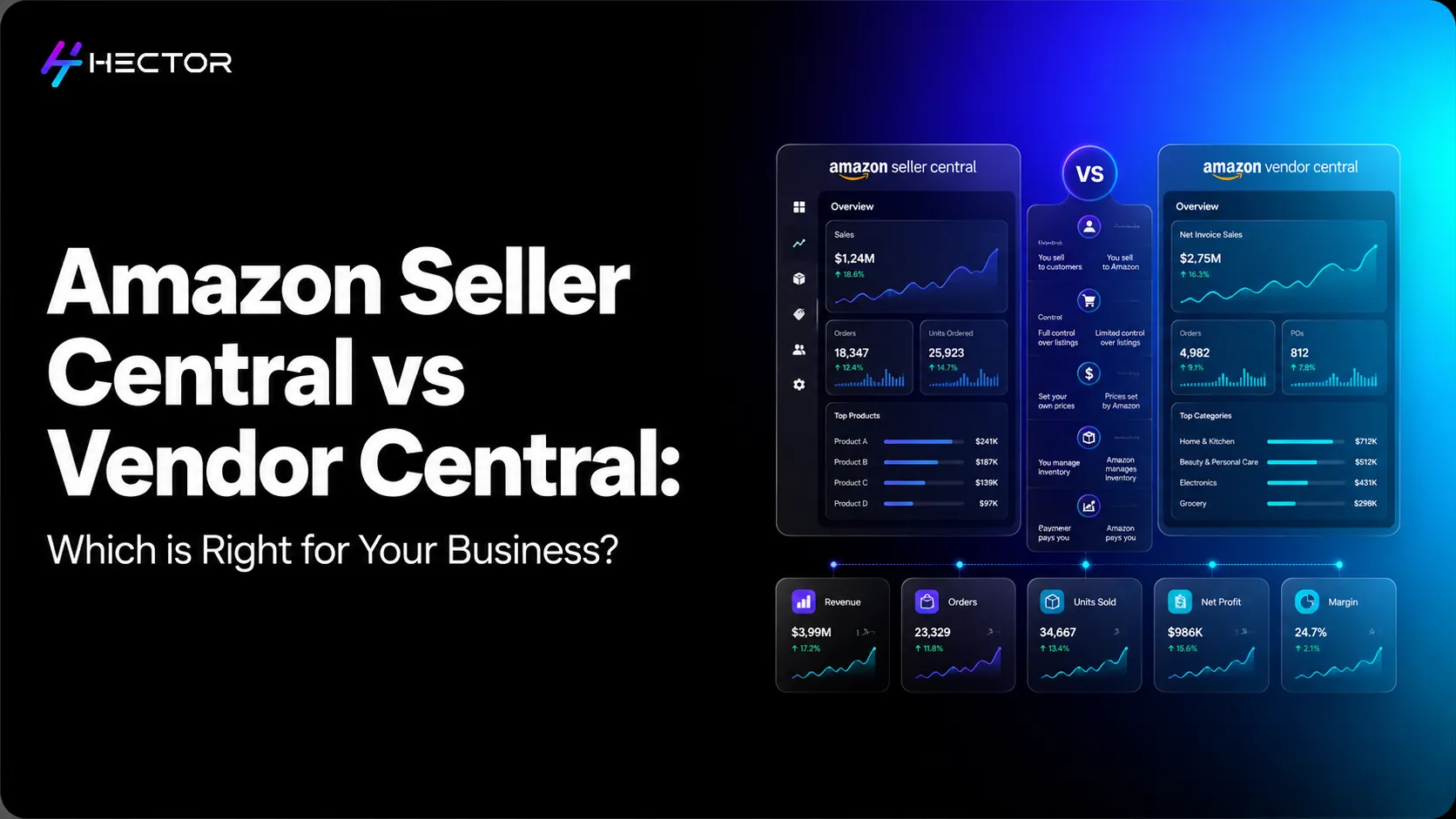
A mid-sized consumer goods company receives an email from Amazon. An Amazon vendor manager has found their products and wants to discuss a wholesale partnership. The founder, who has been running a profitable Seller Central account for two years, isn't sure whether to say yes.
On one hand, Amazon is offering to buy their inventory in bulk. No more worrying about individual order fulfilment, customer returns landing on their metrics, or racing to maintain Buy Box eligibility. Amazon would become the retailer of record for the product. Some brands view this arrangement as beneficial for retail presence and customer confidence, while others prioritise maintaining direct control over pricing and listings.
On the other hand, they'd lose control of their pricing. Amazon could discount their products below MAP. Amazon would manage the listing. Amazon may modify, override, or supplement listing content on Vendor Central listings, which can affect how product information is presented compared with a Seller Central account. And the vendor manager hasn't mentioned chargebacks yet.
This is the Seller Central vs Vendor Central decision. It's not a simple upgrade from one to the other. It's a fundamentally different commercial relationship with Amazon, with different trade-offs, different economics, and different implications for how you run and grow your brand.
In Hector AI's analysis of 4,200+ Seller Central accounts in 2025, brands that activated Campaign Manager within 60 days of listing generated 3.1x higher GMV in their first year compared to sellers who relied on organic traffic alone (Hector AI Internal Data, 2025). The advertising infrastructure you can build on Seller Central, and the automation that makes it scale, is one of the key advantages the 3P model holds over 1P that most comparison guides never adequately address.
This guide covers both platforms fully: what each one is, how they compare across every dimension that matters, who each one is right for, and how your choice affects your advertising strategy.
What Seller Central and Vendor Central Actually Are
Seller Central, The Self-Managed Selling Model (3P)
Vendor Central, The Wholesale Model (1P)
The Core Relationship Difference: Who Is Amazon's Customer?
This is the simplest way to understand the fundamental difference between the two models:
In Seller Central, the end consumer is your customer. You're selling to them through Amazon's marketplace. Amazon provides the infrastructure (search, checkout, FBA) and takes a fee for that service.
In Vendor Central, Amazon is your customer. You're a wholesale supplier. Amazon buys your products from you, marks them up, and sells them to consumers. Everything the consumer sees, the price, the Prime badge, the 'Ships from and sold by Amazon.com' label, is Amazon's.
This single difference in the customer relationship cascades into every other distinction between the two platforms: pricing control, advertising access, listing management, cash flow, and the nature of the risk each model carries.
The Full Comparison, Every Dimension That Matters
Advertising Capabilities, Where the Platforms Diverge Most
Both Seller Central and Vendor Central offer access to Amazon's self-serve advertising products. But the level of control, the data available, and the ability to build automated systems differ significantly between the two, and this is the dimension most comparison guides get wrong by treating it as equivalent.
Sponsored Products and Sponsored Brands Access
Both platforms provide access to Sponsored Products and Sponsored Display, while certain brand-focused advertising and content capabilities may require Brand Registry eligibility. At the feature level, the access looks similar. At the execution level, it is not.
In Seller Central, your advertising campaigns draw from your own account data: your own conversion history, your own keyword performance, your own search term reports. Advertisers can generally access campaign reporting through Amazon Ads and use available reporting datasets to support keyword research, bid optimisation, performance analysis, and automation workflows.
In Vendor Central, the advertising console (Amazon Ads) is connected to your vendor account. Still, the reporting, attribution, and operational datasets differ from those available in Seller Central, making direct comparisons difficult. Vendor Central brands generally have less direct control over listing content, as Amazon may modify, override, or supplement product detail pages. Your conversion data reflects Amazon's retail operation on your products, not your brand's direct selling. The reporting tools, attribution metrics, and operational datasets available to Vendor Central and Seller Central advertisers may differ, which can influence how advertisers analyse performance and build optimisation strategies.
Advertising Automation Considerations Across Seller Central and Vendor Central
One of the key advertising differences between the two platforms is how automation workflows are implemented and managed within each operating model.
Seller Central advertisers can use automated bid rules and workflow tools to help manage campaigns at scale. The effectiveness of these approaches depends on campaign structure, available data, business objectives, and the advertiser's operational model. In Hector AI's analysis of 2,400+ Seller Central campaigns, automated bid rules reduced average CPC by 18% compared to manually managed campaigns over the same 90-day period (Hector AI Internal Data, Jan–Dec 2025). That efficiency advantage compounds as your keyword portfolio grows.
Vendor Central and Seller Central advertisers operate within different commercial and reporting environments. As a result, automation strategies and performance analysis may require different approaches depending on the available datasets and operational factors. The wholesale relationship means your conversion data includes Amazon's retail margin, Amazon's promotions, and Amazon's pricing decisions, all of which affect the signals your advertising system receives.
Why Vendor Central Advertising Is Harder to Control
When you're a vendor, Amazon controls the pricing of your products. If Amazon runs a promotion on your category and discounts your product by 20% to drive volume, your conversion rate spikes, but the spike reflects Amazon's pricing decision, not the performance of your advertising. Your ACoS may look excellent during the promotion and poor immediately after, with no underlying change in your ad strategy.
This variability in the data signal makes systematic advertising optimisation harder on Vendor Central. The sponsored ads data reflects a commercial environment you don't fully control, which means the automation rules you'd ideally build require more manual interpretation and override than equivalent rules on Seller Central.
Pricing Control and Why It Matters More Than Most Sellers Realise
Pricing control is often listed as a Vendor Central disadvantage without much elaboration. The actual implications are more significant than most comparison guides convey.
The MAP Enforcement Problem on Vendor Central
Most brands selling consumer products have a Minimum Advertised Price (MAP), the lowest price at which they allow their products to be sold or advertised in the market. MAP is a brand protection tool that prevents price erosion and maintains the perceived value of the product.
In many jurisdictions, Amazon independently determines retail pricing on products it owns as a retailer, which may create challenges for brands attempting to maintain MAP strategies. Once Amazon purchases inventory as a retailer, it generally retains discretion over retail pricing decisions, subject to applicable laws, contractual arrangements, and internal pricing strategies. Because Amazon controls retail pricing for products it owns, brands may encounter situations where retail prices differ from their preferred MAP strategy. The extent to which a brand can influence pricing outcomes depends on applicable laws, agreements, and the specific commercial relationship.
This is not a hypothetical scenario. Amazon frequently updates retail pricing across its catalogue using automated systems and business rules. A brand that has spent years building price integrity in the market, maintaining MAP across retail partners, can see Amazon undercut that pricing immediately after becoming a vendor, triggering price-matching from other retailers and permanently damaging the brand's price architecture.
How Seller Central Keeps Pricing in Your Hands
On Seller Central, sellers generally set their own consumer prices, subject to Amazon's pricing policies and fair-pricing requirements. You can update them whenever you choose. You can run promotions, set coupon amounts, and adjust prices by ASIN, by day, or in response to competitive dynamics, all without Amazon's involvement. Brands can generally implement and monitor their own pricing strategies, although marketplace pricing outcomes remain subject to Amazon's policies and broader market dynamics.
This pricing control isn't just about protecting margin. It directly affects your advertising performance: as we covered in our guide to automated pricing, your conversion rate is a function of your price position relative to competitors. When you control pricing, you control a core input into your advertising efficiency.
The Vendor Central Chargebacks and Compliance Problem
This is the dimension of Vendor Central that brands consistently underestimate before becoming vendors, and consistently cite as one of the most operationally burdensome aspects of the relationship after joining.
Seller Central sellers are generally not subject to Vendor Central compliance chargebacks. However, they may still encounter other account-level financial adjustments, including FBA-related fees, reimbursement claims, policy enforcement deductions, customer refunds, or inventory-related charges, depending on their fulfilment model and account activity.
What Chargebacks Are and Why They Hurt 1P Margins
When a vendor receives a purchase order from Amazon and fulfils it, Amazon reviews the shipment for compliance with a detailed set of requirements: labelling standards, packaging specifications, carton dimensions, EDI (electronic data interchange) data accuracy, delivery windows, and more. Depending on the nature of the compliance issue and the applicable programme requirements, Amazon may apply deductions or chargebacks that affect invoice payments.
The financial impact of chargebacks varies depending on the type of compliance issue, shipment characteristics, operational processes, and the specific deductions applied by Amazon. Chargeback exposure varies significantly based on factors such as vendor operational maturity, compliance processes, product category, fulfilment accuracy, and overall supply-chain performance. Vendors with strong compliance programmes may experience lower chargeback rates than those still developing their operational capabilities. This isn't a one-time onboarding cost; it's an ongoing operational discipline that requires dedicated compliance management.
The Compliance Burden Most Vendors Underestimate
Vendor Central compliance is a function of operational precision and systems capability. Large suppliers with dedicated EDI teams, automated packaging standards, and established Amazon fulfilment workflows handle it efficiently. Smaller or less operationally mature brands often discover that the margin gain from wholesale pricing is partially or fully eroded by chargeback costs while they scale their compliance capabilities.
The Decision Framework: Which Platform Fits Your Situation
Rather than listing generic pros and cons, here is a decision framework based on your specific business situation. The right platform depends on your scale, your operational capabilities, and your priorities around control, growth, and advertising.
When Seller Central Is Clearly the Right Choice
Seller Central is often a strong fit for brands that prioritise pricing control, operational flexibility, and direct management of their Amazon business, particularly when:
• You're launching a brand and need to test, iterate, and maintain pricing flexibility during the growth phase
• Your margins are tight, and chargeback risk would meaningfully compress profitability
• You want to build a systematic advertising strategy using automated bid rules, keyword harvesting, and data-driven optimisation
• Brand integrity, including MAP enforcement, is central to your commercial strategy
• You don't have operational infrastructure to handle EDI compliance, chargebacks, and purchase order fulfilment at scale
• You're in a category where Amazon's wholesale pricing decisions could damage your broader retail relationships
When Vendor Central Makes Sense
Vendor Central can be the right model when:
• You're a large, operationally mature manufacturer with an established wholesale distribution infrastructure and an EDI team
• Amazon volume represents a small portion of your total distribution, so pricing decisions by Amazon don't destabilise your market
• You receive a Vendor Central invitation, and the volume Amazon commits to purchase provides significant working capital advantages
• Your product category is dominated by 1P listings, and your inability to compete as a 3P seller is limiting growth
• You have a dedicated Amazon/vendor management team that can handle compliance, chargebacks, and purchase order logistics without degrading other business operations
The Hybrid Model: Using Both Platforms Simultaneously
Many brands operate on both Seller Central and Vendor Central simultaneously, a model sometimes called hybrid selling. In this structure, the brand sells some SKUs as a vendor (1P) and others as a seller (3P), often with different objectives for each.
What Seller Central Means for Your Advertising Strategy
If you're operating on Seller Central, whether exclusively or alongside Vendor Central, the advertising opportunity is structurally larger and more controllable than most sellers initially leverage.
The Automation Advantage That 3P Brands Hold
Seller Central advertisers generally have direct access to campaign, keyword, search-term, and product-level reporting through Amazon Ads, subject to the reporting features available in their marketplace and account. These reporting datasets can be used to inform campaign optimisation, automation workflows, and performance analysis, depending on the advertiser's tools, account access, and operational approach.
The compounding effect of this automation is significant. A Seller Central brand with automated bid rules managing 600 keywords, increasing bids on high-converting terms, decreasing on wasted spend, and harvesting new terms from auto campaigns, is building a performance advantage that manual management cannot replicate at that scale. Brands ready to scale beyond search can extend this advantage with Amazon DSP to reach high-intent audiences across Amazon-owned and third-party inventory. The advantage grows with catalogue size: the more SKUs you advertise, the more the automation advantage compounds versus a manually managed alternative.
Building the Foundation: Ads That Scale With Your Catalogue
The most important advertising decision for a Seller Central brand is building a campaign infrastructure that can scale with the business rather than requiring proportionally more management time as the catalogue grows.
Three elements of that infrastructure:
• A consistent campaign structure, auto-discovery campaigns for keyword research, manual exact-match campaigns for proven performers, and Sponsored Brands for brand visibility at the top of search, that can be replicated across new ASINs without rebuilding from scratch.
• Automated bid rules that apply consistent optimisation logic across the entire keyword portfolio, eliminating the human review bottleneck that limits manual campaign management at scale.
• A keyword management process that uses available search-term reporting to identify relevant queries for expansion, refine targeting strategies, and add negative keywords where appropriate, helping improve campaign efficiency over time.