

Keywords are typically the key to success on Amazon PPC. If you choose the correct ones, you will be in front of eager customers just when they are prepared to make a purchase. If you choose the incorrect ones, you're essentially setting your advertising cash on fire.
The difficult part? Keywords change throughout time. While brand-new, valuable search queries appear every day, a keyword that generated conversions the previous week can abruptly disappear. Managing a tsunami of data by hand can be like trying to save a sinking ship.
Successful advertisers create amazon keyword harvesting funnels for this reason. With the help of these funnels, you can find, test, and scale high-performing search terms in an organized manner, ensuring that your campaigns keep up with rather than lag behind consumer behavior.
What Is Keyword Harvesting?
The process of gathering and converting search phrases from your ads and promoting them into more specialized targeting categories is known as keyword harvesting.
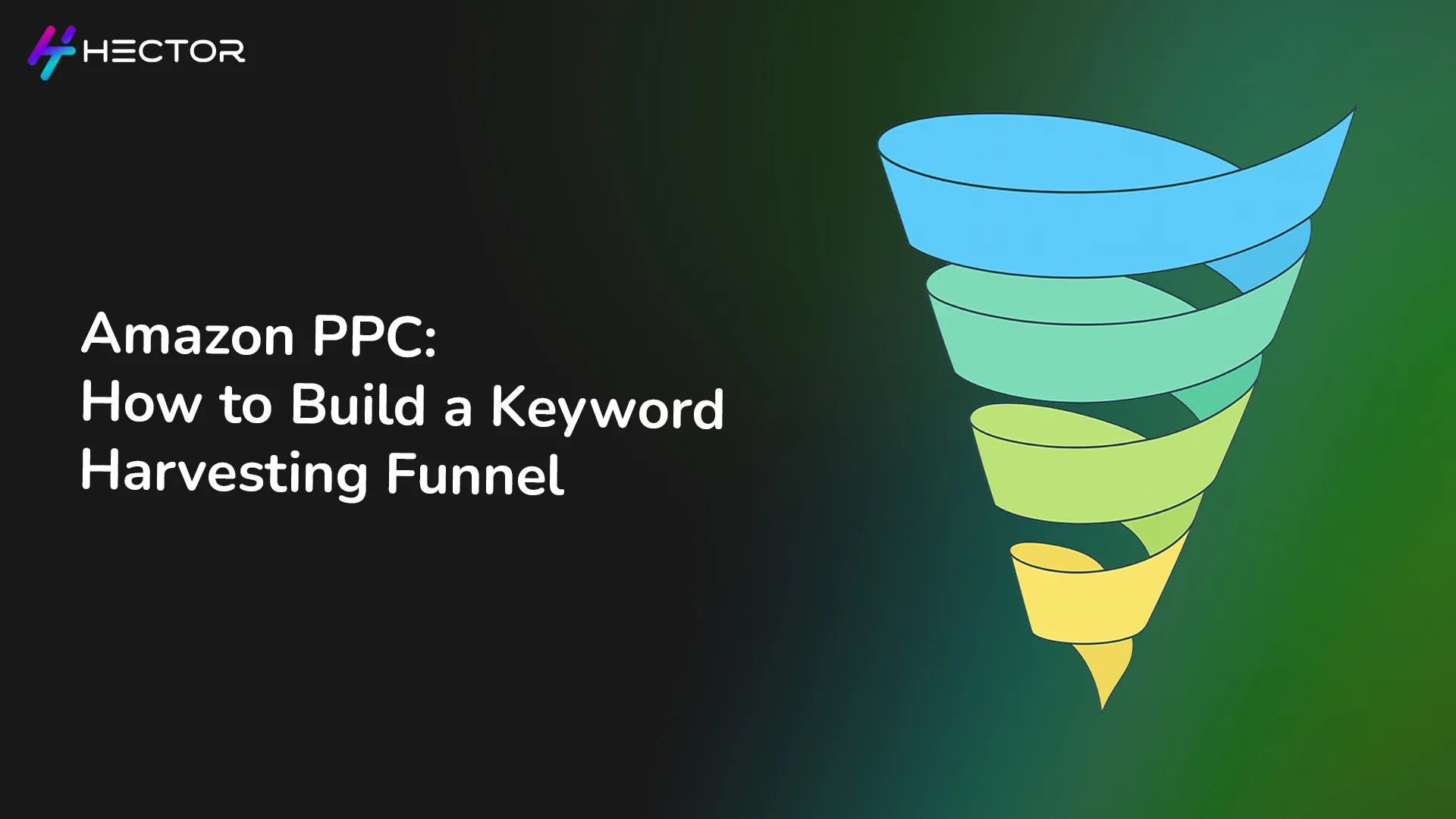
Think of it like a funnel:
Auto campaigns: Broad catch-all for discovery
Phrase or Broad campaigns: Test ground for promising queries
Exact match campaigns: Home for proven winners where bids and budgets are tightly controlled
Simultaneously, underperforming terms are eliminated by adding them as negatives, guaranteeing that your advertising budget is not being wasted.
Profitable queries escape detection without this procedure, and your campaigns continue to be reduced by wasted spend terms.
The Keyword Harvesting Funnel in Action
A classic funnel looks like this:
Automatic Campaigns
Amazon chooses what to show.
Role: Uncover new customer search behavior.
Broad/Phrase Campaigns
Harvested queries from auto campaigns are placed here.
Role: Test with some flexibility while still controlling match variations.
Exact Campaigns
Only the best performers “graduate” here.
Role: Precision targeting with optimal bids and budgets.
Negatives avoid overlap, and each step feeds into the next. Your campaigns remain profitable and lean, thanks to this continuous cycling.
ASIN Harvesting: Different Targeting, Same Logic
In addition to keyword harvesting, ASIN harvesting from auto or PAT (Product Attribute Targeting) campaigns—where high-performing ASINs are pushed to manual product targeting campaigns—follows the same funnel logic. This guarantees that you are using top-converting competitors or complimentary ASINs in addition to keyword optimization to increase reach and profitability.
Why Most Sellers Struggle
Harvesting is easy in theory. In reality, it's disorganized.
Analyzing search phrase reports takes a lot of time and is difficult.
Errors are common with bulk uploads.
Hours of manual sorting may be required to determine which terms are "winners" and which are "waste."
Harvesting keywords becomes less of a growth lever and more of a work for sellers who oversee dozens of campaigns across several ASINs.
Doing Keyword Harvesting Faster with Hector
The good news is that bulk sheets and complicated exporting are no longer an option.
With Hector, you can:
Find popular search terms that aren't in your targeting mix right away.
From the dashboard, add them straight to different ad groups or ongoing campaigns.
Give up the monotony of Excel and concentrate on scaling what works.
"Set-and-forget automation" is not what this is. You still have control over which keywords advance up the funnel, but Hector makes decisions and executes them really quickly. You act on insights in seconds rather than wasting hours finding and transferring keywords.
The majority of advertisers want precisely that balance—automation of discovery, human judgment in execution.
How to Automate a Keyword Harvesting Funnel
Step 1: Define Promotion & Pruning Rules
You must have well-defined thresholds before you can set automation. For instance: If a term generates ≥3 conversions at ACOS < 30%, promote it. If a term gets ≥15 clicks but no sales, it should be rejected.
These cutoff points ought to line up with your growth objectives and margins.
To guarantee data dependability before making funnel selections, the majority of marketers typically only promote terms after 2 to 3 conversions and at least thirty clicks.
Step 2: Set Up Campaign Structure
Maintain the funnel's cleanliness:
1 Auto campaign per product/ASIN
1 Broad/Phrase campaign per product
1 Exact campaign for proven winners
This division guarantees that the keywords that are harvested do not compete with one another.
Step 3: Implement Automation
To create automation rules, use Hector or Amazon's bulk operations. Every day or every week, the automated system analyzes search term performance and applies the following rules:
Moves profitable queries up the funnel
Adds negatives to lower tiers
Adjusts bids to optimize and reduce ACOS
Spend volume and data velocity define the optimal frequency; high-spend accounts should harvest every day, but smaller portfolios can do so once a week without sacrificing optimization accuracy.
Step 4: Monitor & Refine
"Set and forget" is not the definition of automation. Evaluate performance every week. You might advertise too few keywords if the ACOS targets are overly strict. If it's too permissive, you can spend money on underperforming employees.
Pro Tips for Smarter Funnels
Remember these to get the most out of your harvesting funnel:
Use layered negatives: To prevent double bidding, always negate a promoted keyword in lower stages.
Set clear thresholds: Promote a keyword if it has three or more conversions at an ACOS of less than 30%, and negate it if it receives fifteen clicks but no purchases.
Look for long-tail gems: Harvesting reveals that many profitable searches are long tails with low volume and little competition.
Pair harvesting with listing optimization: Only when your listing is relevant enough to convert will a keyword be effective.
Logic of Negative Keywords by Funnel Stage
As keywords progress up the funnel, strategically add negatives to avoid redundancy and unnecessary spending:
Auto: Ignore precise matches that are transferred to broad campaigns.
Broad: Reject winners who advance to Exact campaigns.
This guarantees that every campaign fulfills its own objective and maintains your funnel layers fresh.
Final Word
The core of Amazon PPC optimization is a keyword gathering funnel. It guarantees that you're progressively accumulating a portfolio of high-ROAS search phrases that promote profitable development rather than merely chasing traffic.
Additionally, hand harvesting quickly becomes unmanageable at scale, even though it works for small catalogues. Hector and similar tools can help make the harvesting process far less painful, faster, and cleaner.