

A shopper finds your product on Amazon. They read the title. They scroll through the images. They check the reviews, three minutes of serious consideration. Then they get distracted, close the tab, and spend the next week doing something else.
From your perspective as a seller, that shopper has left your product detail page without purchasing. While Amazon advertising offers retargeting options through formats such as Sponsored Display, Amazon DSP provides a broader audience reach across Amazon-owned and participating third-party inventory, allowing brands to re-engage eligible shoppers beyond the initial browsing session.
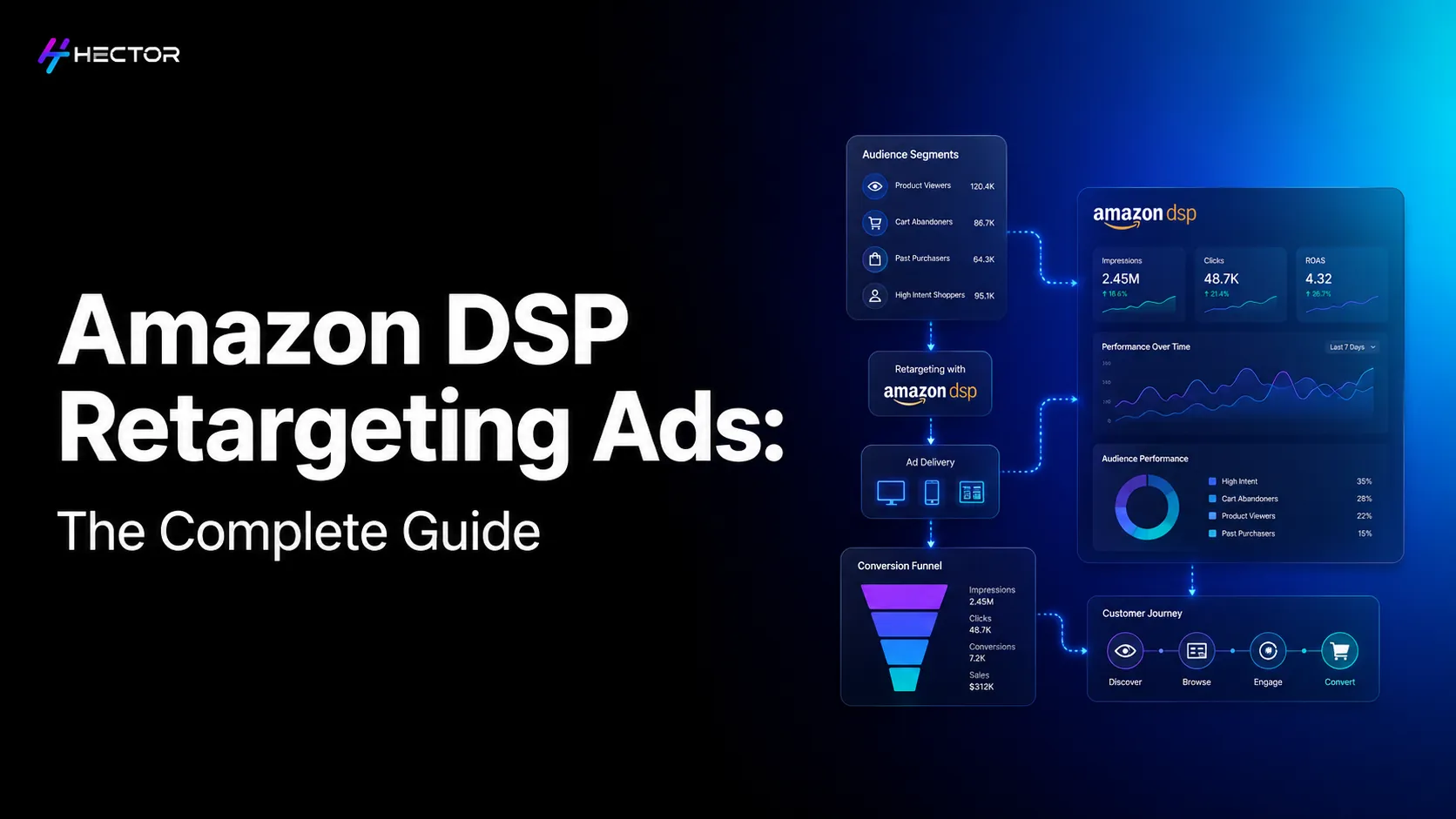
Amazon DSP retargeting is the system that bridges the gap between 'visited your listing' and 'completed the purchase'. Using Amazon audience signals, it can reach eligible shoppers across Amazon-owned properties and participating third-party websites, apps, and streaming environments after they leave your product detail page, helping brands stay visible while purchase consideration remains active.
This is meaningfully different from Sponsored Display retargeting, which most sellers are already familiar with. DSP retargeting generally offers broader inventory access, more advanced audience segmentation capabilities, and a different buying model than Sponsored Display. Understanding the distinction determines whether DSP retargeting belongs in your strategy, and when.
In Hector AI's analysis of 640 DSP accounts across Q1–Q4 2025, brands combining Amazon DSP retargeting with Sponsored Products saw a 38% higher purchase rate among retargeted audiences compared to brands running Sponsored Products alone (Hector AI Internal Data, 2025). The premium of DSP retargeting over Sponsored Display comes from reach, data depth, and the ability to re-engage shoppers who have left Amazon entirely.
This guide covers how DSP retargeting works, how it compares to Sponsored Display, how to access it, how to build your first campaign, and, the part most guides skip, when the investment is actually justified.
What Amazon DSP Retargeting Actually Is
Definition: DSP vs Programmatic vs Remarketing, One Clear Explanation
Three terms that appear together and confuse separately:
• Programmatic advertising, automated buying of ad inventory across multiple publishers via technology, rather than direct deals. DSP is a programmatic system.
• DSP (Demand-Side Platform), the technology that lets advertisers buy this inventory at scale, using data to target specific audiences. Amazon DSP is Amazon's proprietary DSP.
• Retargeting / Remarketing, the specific use of audience data to re-reach people who have already interacted with your brand. Both terms mean the same thing; 'retargeting' is more common in US usage.
Amazon DSP retargeting is therefore: programmatic advertising that retargets Amazon shoppers using Amazon's own data, executed through Amazon's demand-side platform. All three concepts at once.
Where Amazon DSP Retargeting Ads Appear
Amazon DSP vs Sponsored Display: The Retargeting Comparison That Matters
Both Amazon DSP and Sponsored Display offer retargeting. The question most sellers don't ask, and most guides don't answer clearly, is: what's the actual difference, and when does DSP justify the additional complexity and cost?
Audience Depth: What Each Platform Knows About Your Shopper
Sponsored Display retargeting uses Amazon shopping and browsing signals available within its self-serve audience framework, including product views, category engagement, and relevant shopping activity. These signals help advertisers reach shoppers based on their interactions within Amazon's ecosystem.
Amazon DSP campaigns can be analyzed and refined using Amazon Marketing Cloud (AMC), subject to advertiser eligibility and access. AMC is a clean-room analytics environment that allows advertisers to run privacy-safe queries across aggregated campaign and purchase data.
With AMC, you can build custom audience segments: shoppers who viewed your product and a competitor's product in the same session, shoppers who purchased from you more than 90 days ago (repurchase targeting), or shoppers who saw a DSP ad and later converted organically without clicking.
This segmentation capability is what makes DSP retargeting more precise than Sponsored Display.
Placement Reach: On-Amazon vs the Open Web
The Cost Model Difference and What It Means for ROI Measurement
Sponsored Display supports CPC and viewable CPM pricing models, while Amazon DSP primarily uses CPM-based buying. Because DSP performance is often evaluated using impression-based metrics and attributed conversions, its measurement approach differs from click-centric advertising formats.
Amazon DSP primarily uses CPM-based pricing, although campaign optimization methods and performance objectives may vary by campaign setup. This means your DSP retargeting campaign is reaching thousands of shoppers without requiring any of them to click. The conversion happens later, when the shopper returns to Amazon, remembers your product, and purchases either through an ad click or through organic search. This is called view-through conversion, and it makes measuring DSP ROI more complex than measuring Sponsored Products or Sponsored Display.
How Amazon DSP Retargeting Works: The Mechanics
First-Party Data: Why Amazon's Audience Signals Are Different
Amazon's audience targeting capabilities are built on first-party shopping and browsing signals. Unlike platforms that often infer purchase intent from content consumption or search behavior, Amazon can use aggregated and privacy-safe shopping signals to help advertisers reach relevant audiences based on shopping activity and engagement patterns.
When advertisers target in-market audiences through Amazon DSP, audience eligibility is generally based on aggregated shopping and browsing behavior within relevant categories. Rather than relying solely on inferred interests, these privacy-safe audience segments are designed to help brands engage audiences who have demonstrated category-related shopping activity within Amazon's ecosystem.
Audience Types: Purchase Retargeting, Views Retargeting, and Lookalikes
View-Through Attribution Explained for Non-Technical Readers
View-through attribution is one of the most misunderstood concepts in DSP advertising, and one of the most important for evaluating whether your campaigns are working.
Here's how it works in plain English: a shopper sees your DSP retargeting ad on a news website. They don't click. Three days later, they open Amazon, search for your product category, find your listing, and buy. Under the campaign's configured attribution settings, Amazon may attribute that conversion to the DSP campaign if it occurs within the applicable view-through attribution window.
DSP view-through attribution windows can vary based on campaign setup and attribution configuration, with 14 days being a commonly used default. If a conversion occurs within the configured attribution window after an ad exposure, it may be attributed to the campaign according to the selected measurement settings.
As a result, DSP reporting may capture conversions that occur after an ad exposure without a click, depending on the attribution settings being used. This can provide a broader view of campaign influence than click-only measurement.
Accessing Amazon DSP: Your Options as a Seller
Managed Service vs Self-Service DSP
Amazon's managed-service DSP offering is a traditional access route in which Amazon manages campaign setup, audience selection, creative trafficking, and optimization on behalf of the advertiser. Managed-service engagements typically require higher minimum commitments, although thresholds vary by region, partner, advertiser eligibility, and engagement model. In exchange, you get Amazon's managed service team, access to all DSP inventory, and account management support.
Amazon's self-service DSP provides direct access to the DSP interface without the managed-service layer. Access is generally available to eligible advertisers, agencies, and partners based on Amazon's approval criteria and program requirements. Self-service access is subject to Amazon's eligibility requirements and approval process. Qualification criteria may vary based on advertiser profile, account status, region, and program availability.
Working With an Amazon Ads Partner
For most brands, the practical path to DSP retargeting is through a certified Amazon Ads partner, an agency or technology provider that has access to DSP inventory and can run campaigns at lower minimum thresholds than Amazon's managed service. Partners handle the technical setup, audience building, and creative trafficking, while you control strategy and budget.
Setting Up Your First DSP Retargeting Campaign
Step-by-Step: From Audience Selection to Going Live
Frequency Caps and Why They Matter More Than Most Sellers Realise
Frequency capping limits how many times the same shopper sees your ad within a defined window. DSP allows you to set frequency caps at the campaign or line item level, for example, no more than 3 ad impressions per shopper per day.
Without frequency caps, DSP retargeting campaigns can show the same ad to the same shopper dozens of times in a 24-hour window. This behaviour has two negative effects: creative fatigue (the shopper becomes desensitised to your ad, CTR drops, and conversion rate falls) and brand damage (over-served shoppers associate your brand with intrusive advertising).
Using Amazon Marketing Cloud to Sharpen DSP Retargeting
Amazon Marketing Cloud (AMC) is Amazon's clean-room analytics environment. In this secure space, you can run custom SQL queries across your Amazon advertising and purchase data without Amazon exposing individual shopper identities. It's the analytics layer that makes DSP retargeting meaningfully more precise than standard audience targeting.
What AMC Is and What It Shows You About Retargeted Audiences
Through AMC, advertisers can analyze aggregated and privacy-safe insights related to ad exposure paths, attributed conversion behavior, audience overlap across campaigns, and the relationship between ad frequency and campaign outcomes. These analyses can help advertisers better understand campaign interactions and optimize audience strategies.
This data doesn't exist in Campaign Manager. It requires AMC queries, which means either direct AMC access or an AMC-capable partner.
How AMC Audience Refinement Improves Retargeting ROI
Standard DSP retargeting builds audiences from broad behavioural criteria: 'shoppers who viewed this ASIN in the past 30 days'. AMC lets you layer additional qualification: 'shoppers who viewed this ASIN in the past 30 days AND who have purchased in this category within the past 90 days AND who were NOT exposed to a Sponsored Products ad in the same period'.
The refinement narrows the audience but increases its quality dramatically. Smaller, more qualified audiences convert at higher rates and cost less to reach per conversion, because you're not wasting impressions on low-intent audience members who happen to meet the broad retargeting criteria.
Why Manual DSP Campaign Management Breaks at Scale
DSP campaign management has the same fundamental scaling problem as Sponsored Products campaign management, but at a higher cost per mistake.
The CPM Optimisation Problem Human Review Can't Solve
In a Sponsored Products campaign, the optimisation loop is relatively tight: keyword → click → conversion → ACoS. You evaluate weekly, adjust bids, and add negatives. The feedback cycle is fast enough that weekly human review catches most issues before they become expensive.
In a DSP retargeting campaign, the optimisation loop is broader: impression → recall → eventual conversion (sometimes via organic search) → view-through attribution. The signal is diffuse, and the timing is unpredictable. A CPM bid set last Tuesday may be overpaying on an audience segment whose conversion rate has declined because a competitor launched a promotion and is capturing those shoppers' purchasing intent. A human review on Friday doesn't catch Tuesday's problem.
DSP campaigns often operate across multiple audience segments, placement types, creative variations, bidding strategies, and frequency settings simultaneously. As these variables increase, campaign complexity grows significantly, creating additional optimization and measurement challenges.
How Automation Closes the Gap
Automated rules for DSP campaigns apply CPM bid adjustments, audience segment allocations, and frequency cap enforcement on a daily cadence, responding to actual performance data rather than a weekly human review.
The rules are structurally similar to other advertising automation workflows: define the conditions, define the actions, and execute adjustments based on performance data. Optimization metrics may include detail page view rate (DPVR), view-through conversions, CPM efficiency, attributed sales performance, and other campaign-specific performance indicators.
When DSP Retargeting Is Worth It, And When It Isn't
DSP retargeting is not right for every brand at every stage of growth. Being clear about when it adds value and when Sponsored Display covers the same ground more efficiently is the most useful thing this guide can offer.
The Budget Threshold Where DSP Makes Sense
The viability of DSP retargeting depends on multiple factors, including audience size, advertising maturity, category economics, measurement capabilities, and operational readiness. While advertising spend is an important consideration, it should be evaluated alongside these broader business and marketing factors.
For advertisers with limited audience scale, developing advertising programs, or constrained operational resources, other Amazon advertising solutions may provide a more practical starting point. The appropriate mix of advertising products should be determined by business objectives, audience opportunity, and measurement capabilities.
The ROI Case: DSP vs Doubling Sponsored Display Spend
The 38% lift in purchase rate among retargeted audiences doesn't appear at low spend levels; it requires sufficient audience size, adequate DSP impression volume, and a Sponsored Products foundation that's already converting profitably. DSP is generally most effective when integrated with an established advertising strategy and supported by clear audience, measurement, and optimization frameworks.