

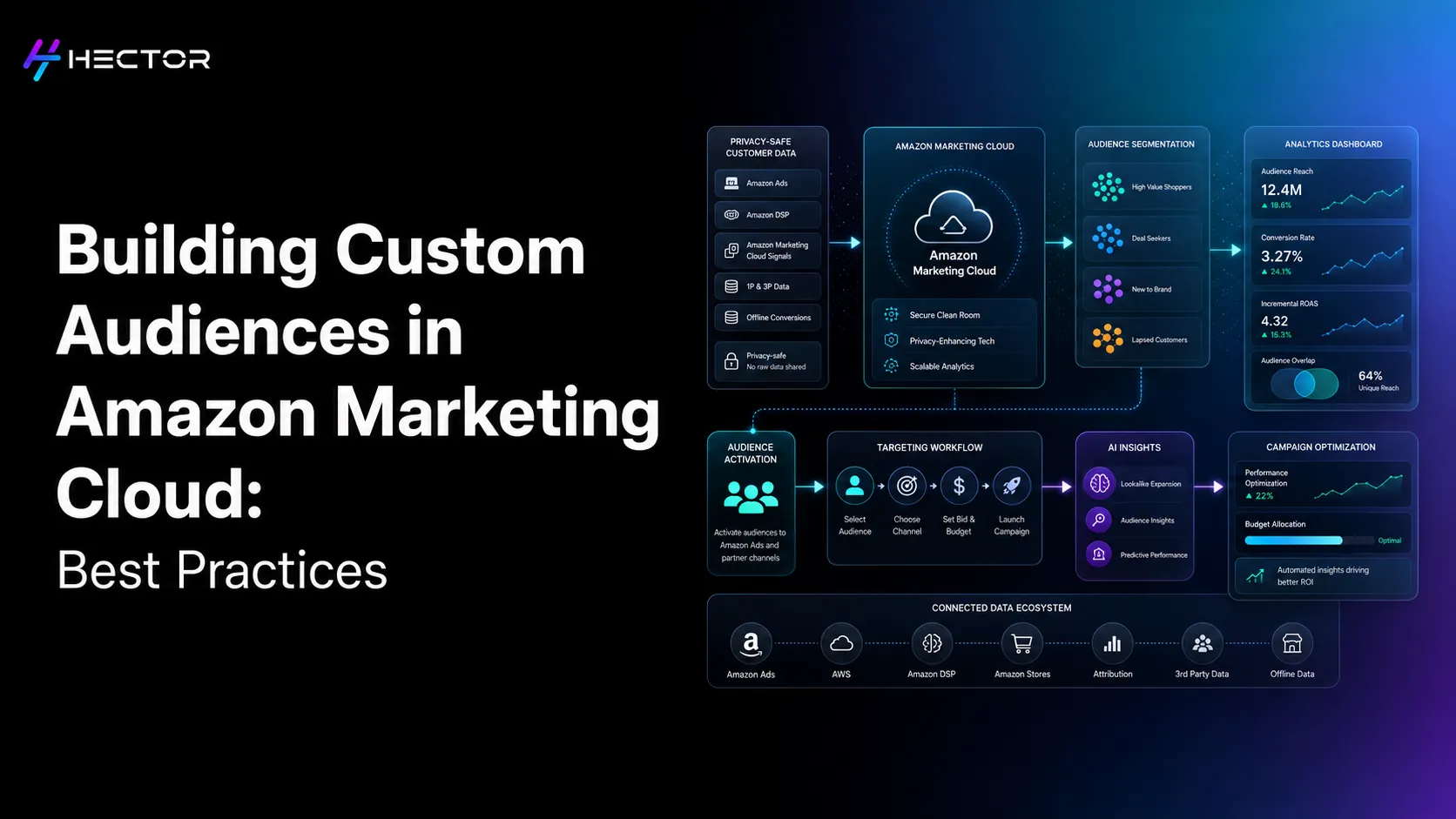
Amazon Marketing Cloud (AMC) has emerged as a powerful tool for marketers aiming to gain deeper insights into audience behavior, allowing for sophisticated audience building and precise targeting.
AMC provides an unparalleled level of transparency, flexibility, and data granularity. However, success in creating custom audiences within AMC depends on a strong grasp of the platform's capabilities and the application of best practices.
What is Amazon Marketing Cloud (AMC)?
AMC is a cloud-based platform that allows advertisers to analyze performance data across different Amazon Advertising products. It enables marketers to execute queries on raw, anonymized data to unlock insights, optimize campaigns, and create customized audiences that can be targeted through Amazon DSP ads
Why Custom Audiences Matter?
Custom audiences enable advertisers to focus their resources on the most relevant users. Instead of relying on broad, predefined segments, custom audiences allow for personalized targeting based on behavior, demographics, purchase history, and engagement patterns.
This leads to better campaign performance, improved ROAS, and deeper customer relationships.

Best Practices for Building Custom Audiences in AMC
1. Leverage Multiple Data Sources
When building custom audiences, it's essential to blend multiple data sources such as:
First-party data: Data collected from your captive audiences and your campaigns, including customer demographics, purchase behavior, and interaction history.
Amazon Shopping Insights: Use insights like purchase frequency, product categories browsed, or recently viewed items to segment audiences more effectively.
Sponsored Ads & DSP Activity Data: Information on users who interacted with your ads, including branded searches, impressions, clicks, and conversions.
For example, you might want to target users who have wishlisted a particular product but have not yet made a purchase. Combining these insights with engagement data from your Sponsored Ads or DSP campaigns will help you build a more comprehensive audience.
2. Time Window Segmentation
Timing is crucial when creating custom audiences. AMC allows you to set time windows for specific user behaviors, such as purchases or interactions. This gives you the ability to target users based on when they last interacted with your brand, offering more relevant and timely messaging.
Recency Targeting: Target users based on how recently they’ve interacted with your brand. For example, you might create an audience of users who abandoned a cart within the last seven days but didn’t make a purchase. These users are prime for retargeting with personalized messaging.
Lapsed Customer Targeting: AMC enables you to re-engage users who have not purchased within a set time frame, such as 90 or 180 days. This could be a strong re-engagement strategy for a holiday campaign or new product release.

3. Audience Overlap Analysis
AMC offers tools for understanding audience overlap between different segments. By examining overlaps, you can identify shared behaviors between various groups and fine-tune your messaging. For instance, you might discover that customers who purchase sports equipment also show interest in health supplements.
Cross-Selling Opportunities: Use audience overlap to identify potential cross-sell opportunities. For example, target users who have purchased electronics accessories like phone cases and offer them other related items such as wireless chargers or screen protectors.
Budget Optimization: Understanding overlap helps in reducing wasted ad spend by avoiding redundant targeting across different campaigns.
4. RFM (Recency, Frequency, Monetary) Segmentation
Recency, frequency, and monetary (RFM) analysis is a tried-and-tested method to segment audiences based on their past purchasing behavior. AMC enables brands to perform RFM segmentation at a granular level, enabling you to customize offers based on the customer’s historical spend and engagement.
High-Value Customers: Target customers who have made frequent and high-value purchases in the past. Offering them early access to sales or exclusive deals can help foster loyalty.
Low-Frequency Customers: Identify users who engage with your brand infrequently but tend to make higher-value purchases. These users are likely to respond well to product recommendations or flash sales.
5. Exclusion Audiences
Exclusion audiences are just as important as inclusion audiences. By excluding irrelevant or undesirable segments, you ensure that your ad dollars are focused on the most valuable prospects.
Current Customers: Exclude users who have recently purchased the product you’re promoting to avoid redundancy. For example, exclude users who bought a television in the last six months from your campaign promoting the same category of products.
Repeat Converters: While it may be tempting to continually retarget customers who have already converted, focusing on reaching new customers or re-engaging lapsed ones can yield better results.

6. Experiment with Lookback Windows
AMC provides flexibility with lookback windows, allowing you to choose the duration over which to evaluate user behavior. By experimenting with different windows, you can identify which timeframe produces the highest-performing audience segments.
Shorter Windows for High-Intent Products: If you’re selling a high-consideration product like electronics, shorter lookback windows (7-14 days) may allow you to focus on more recent, highly engaged audiences.
Longer Windows for Repeat Purchases: For consumable products like groceries or personal care items, longer windows (30-90 days) may be more effective, as users are likely to make repeat purchases.
Conclusion
Building custom audiences in Amazon Marketing Cloud requires a combination of creativity, strategy, and data analysis. By leveraging multiple data sources, understanding audience behavior, and segmenting based on specific time frames and purchasing patterns, you can significantly enhance the effectiveness of your campaigns.
By following these best practices and tailoring your approach to your unique business needs, you can maximize the value of AMC to build high-converting audiences that drive long-term growth.
With AMC’s custom audience-building capabilities, marketers have the power to create deeply personalized, data-driven campaigns that resonate with their target audiences in ways that were previously unimaginable.
Hector has simplified the audience creation through its intuitive platform & precise insights. If you want to leverage the full potential of Amazon Marketing Cloud, Hector is your go-to platform to unlock the efficiency.