

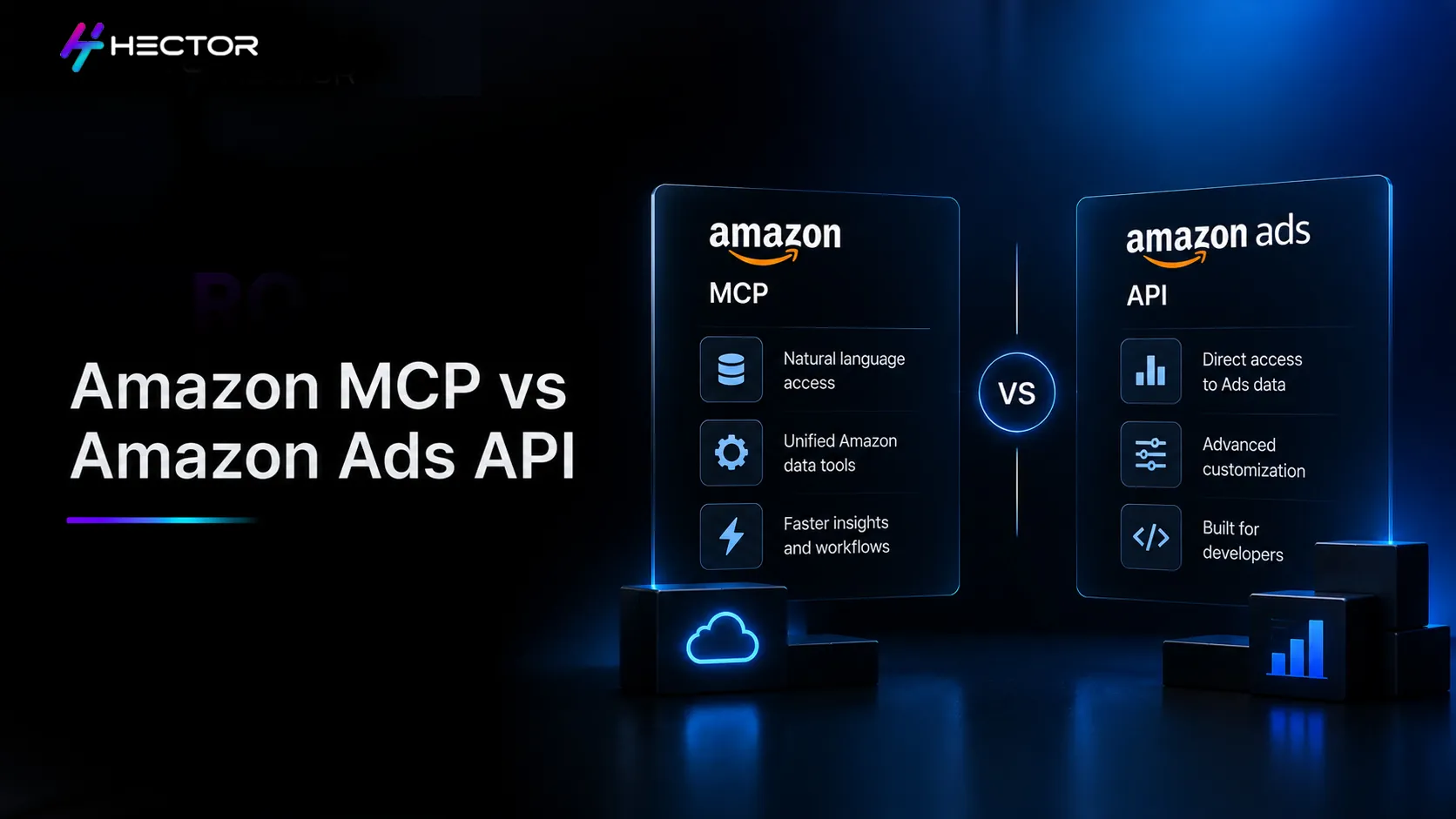
Think about the last time you needed to do something at a bank. You had two choices. You could walk up to the ATM and handle it yourself: quick, available any time, covers most common tasks without any conversation. Or you could walk inside and speak to a bank teller, who could handle more complex requests, answer questions in context, and do things the ATM menu simply cannot offer.
The ATM and the bank teller both give you access to the same underlying account. They are completely different experiences of getting that access.
That is the distinction between Amazon MCP and the Amazon Ads API.
The Amazon Ads API is the developer's direct line into Amazon's advertising platform: structured, precise, powerful, and requires knowing how to use it. Amazon MCP is the conversational layer that lets AI tools do the talking, handling common campaign tasks through plain-English instructions rather than written code. Both access the same system. They serve genuinely different needs.
What Amazon MCP and the Amazon Ads API Actually Are
The Amazon Ads API: The Developer's Direct Line
The Amazon Ads API (Application Programming Interface) is a structured, code-based interface that lets developers build direct integrations with Amazon's advertising platform. A developer sends a structured request in a format Amazon specifies, and Amazon's system responds with the data or confirms the action.
The Amazon Ads API exposes extensive campaign-management capabilities, including creating and updating campaigns, adjusting bids and budgets, managing targeting, and retrieving performance reports. Developers can use these capabilities to build advertising workflows outside the Amazon Ads console. The difference is that you are doing it through code rather than clicking buttons in a console.
The API has been around for years and is what most third-party Amazon advertising tools (bid management software, reporting platforms, agency dashboards) are built on. It is powerful, highly flexible, and gives developers precise control. It is also technical by nature: designed for engineers, not marketing managers.
Amazon MCP: The AI-Friendly Shortcut
Amazon Ads MCP Server provides an AI-friendly interface to Amazon Ads API functionality, allowing AI agents to translate natural-language requests into structured advertising actions and workflows.
Instead of a developer writing code to create a campaign, the marketer types a plain-English instruction to Claude or ChatGPT: "Create a Sponsored Products campaign for my top five ASINs with a $50 daily budget and broad match keywords." The AI interprets the instruction, uses the MCP connection to execute it through the API, and the campaign is built.
MCP provides an AI-friendly interface to Amazon Ads API functionality, allowing AI agents to orchestrate supported advertising operations through natural-language instructions. The Amazon Ads MCP Server currently exposes 50+ tools covering campaign creation, keyword management, budget adjustments, performance reporting, account management, and international expansion.
The Core Difference: Access vs Control
The ATM vs Bank Teller Analogy
The ATM gives you access to common account functions quickly and on your own terms. It handles the standard tasks most people need, most of the time, without queuing. It works at 2 in the morning. But it cannot handle everything. An unusual request, a complex question, something outside the standard menu: you need a real person for that.
The API is like having direct access to a fully equipped professional kitchen. You can make almost anything the available ingredients and equipment support, but you need to know how to cook. MCP is like giving instructions to a skilled assistant who already knows how to use that kitchen. You describe the outcome, and the assistant coordinates the available tools.
What You Get With More Control and What You Give Up for Convenience
With the API, developers have substantially more flexibility to determine how data is retrieved, processed, combined with other systems, and acted upon. That flexibility is still bounded by the capabilities and data Amazon exposes through the API. For development teams building advertising infrastructure, this flexibility is the whole point.
With MCP, the tools are pre-built, and the interactions happen in natural language. You do not need to write code. You do not need to understand the API's data structures. You describe what you want, and the AI handles the implementation. The trade-off is that you are working within the bounds of what the pre-built tools support, which covers a growing set of common Amazon Ads workflows through its available tools.
A Side-by-Side Comparison
Three Audiences, Three Different Answers
If You Are a Developer or Have One Available
The Amazon Ads API is the right foundation. If you are building a custom analytics dashboard, a proprietary bidding engine, a multi-account management system, or any tool that needs to pull, process, and present advertising data in a specific way, the API gives you access to do exactly that.
MCP still has a place even in developer workflows: it is useful for prototyping quickly, for allowing non-technical team members to interact with the account through a conversational interface, or for campaign execution that does not require custom logic. But the API is what you build serious integrations on top of.
If You Are a Marketing Manager or PPC Specialist Without Developer Support
MCP can be a practical option for marketing teams that want a more accessible way to interact with Amazon Ads capabilities through AI. If your goal is to manage campaigns, pull performance data, make bulk adjustments, or launch new Sponsored Products campaigns. You want to do that through an AI assistant rather than clicking through the console or waiting for an engineering resource; MCP covers that workflow.
The connection requires authorized access to the Amazon Ads account. Supported MCP clients can use Amazon's OAuth 2.1 authorization flow to handle authentication through a browser-based authorization process. Beyond that, once a hosted MCP implementation is connected to an AI tool, the day-to-day experience is conversational. The engineering barrier is at setup, not in use.
If You Are an Agency Managing Multiple Client Accounts
The honest answer is that you probably need elements of both. MCP is useful for fast, conversational campaign execution across multiple accounts: the kind of bulk actions that used to take an afternoon can happen through structured natural-language workflows. But for reliable performance reporting, cross-account analytics, and anything that requires consistent metric definitions and historical data, MCP's async reporting and tools-only limitations become relevant.
For agencies with more advanced requirements, one practical architecture is to combine MCP-based workflows with a structured analytics and data layer. The execution speed MCP provides is a genuine operational advantage. The analytical depth required for client reporting usually needs more than what raw MCP can deliver on its own.
When You Actually Need Both
The Execution vs Intelligence Split
Think of it like this: MCP is particularly useful for conversational execution and orchestrating defined advertising workflows. The Amazon Ads API provides the programmable foundation for teams that need custom data pipelines, proprietary analytics, integrations, or optimization logic. For advanced analysis, teams may need a structured analytics layer that uses Amazon Ads API data alongside business logic, historical data, and other data sources.
The emerging pattern for sophisticated advertising teams is to use MCP for the execution workflows: campaign creation, keyword changes and budget adjustments and to use a pre-processed analytics layer (built on the API) for performance analysis and strategic decisions. MCP can simplify conversational execution, while API-based infrastructure can support custom analytics, business logic, integrations, and optimization workflows.
What MCP Does Well and What the API Adds on Top
MCP excels when the task is defined and the outcome is clear. "Create an end-to-end Sponsored Products campaign." "Expand this Sponsored Products campaign to the UK marketplace." "Show me which campaigns are closest to their daily budget cap." These are the kinds of instructions MCP handles cleanly through its pre-built tools.
The API adds depth when the requirement is custom: a specific data join between campaign performance and inventory levels, a proprietary bid model that adjusts based on margin data, a cross-account benchmark report with your own metric definitions. Platforms like Hector Ai build this layer: combining the execution speed of MCP-compatible interfaces with the analytical depth of a pre-processed data infrastructure, Amazon Marketing Cloud provides the attribution and audience intelligence layer that sits above both MCP and API data for deeper campaign analysis. specifically because most serious advertisers eventually need both.
The Honest Limitations of Each
What Amazon MCP Does Not Give You
What the Amazon Ads API Costs You
The Amazon Ads API gives you everything at the price of the engineering work required to use it. Building and maintaining API integrations requires developer time and ongoing maintenance. API endpoints change, authentication flows require updates, and new ad formats need additional engineering when Amazon releases them.
There is also the issue of the blank page: the API gives you access to data, not an understanding of it. A custom integration that pulls raw performance data still needs business logic layered on top before the numbers mean anything useful. The API provides programmatic access to Amazon Ads data and capabilities, but teams still need business logic, analytics, or other systems to turn that data into actionable insights.
For teams with developer resources, this is manageable and worth it. For teams without, the API alone is not a realistic starting point, which is exactly why MCP exists.