

Why Your Bidding Strategy Matters
Keywords determine where you want to compete. Your bids and bidding strategy influence how aggressively you compete for those opportunities.
A bid is the maximum amount you are willing to bid for a click before other applicable bidding adjustments. Your actual CPC can be lower than your bid.
A bid that is too low may limit your ability to win impressions and clicks. A bid that is too aggressive relative to your conversion rate and product economics can make it difficult to maintain your target ACoS or ROAS.
The bidding strategy adds another layer to this decision. It determines whether Amazon can dynamically adjust your bid based on the predicted likelihood of conversion.
Understanding this interaction becomes especially important when you combine base bids, dynamic bidding, and placement bid adjustments.
Amazon's Three Sponsored Products Bidding Strategies
Fixed Bids: Maximum Control Over the Bid You Set
With Fixed Bids: Amazon uses the bid you set without dynamically increasing or decreasing it based on the likelihood of conversion.
For example, if your keyword bid is $1.20, Amazon uses that $1.20 bid for eligible auction opportunities before applicable placement adjustments.
Your actual CPC may still be lower than your bid.
Fixed Bids can be useful when you want tighter control over the bids submitted for a campaign. But they do not guarantee a particular CPC, ACoS, ROAS, conversion rate, or advertising outcome.
That control can be useful, but it also means you are giving up Amazon's ability to adjust the bid dynamically for individual opportunities.
Dynamic Bids: Down Only: Amazon Can Reduce Your Bid
With Dynamic Bids: Down Only, Amazon can reduce your bid in real time when an ad opportunity is considered less likely to convert.
It does not dynamically increase your bid above the amount you have set based on conversion likelihood.
This can make Down Only useful when controlling inefficient spend is an important objective.
Down Only is often worth testing when you want Amazon's conversion signals to help limit bids on lower-probability opportunities.
However, it should not be treated as a mandatory strategy for every new campaign. The appropriate bidding strategy depends on the campaign objective, performance, and the advertiser's tolerance for bid variability.
Dynamic Bids: Up and Down: Amazon Adjusts in Both Directions
Dynamic Bids: Up and Down gives Amazon more flexibility.
Amazon can increase your bid when an opportunity is considered more likely to convert and decrease it when a conversion is considered less likely.
Amazon's current Sponsored Products guidance states that Dynamic Bids: Up and Down can increase or decrease bids by up to 100% for all placements based on performance.
Amazon recommends considering Dynamic Up and Down in scenarios where sales are a key objective, including high-performing campaigns, deal ASINs, excess inventory, and campaigns where advertisers want to compete more aggressively for valuable placements.
There is no Amazon requirement that a campaign must have 30 days of conversion history before using Dynamic Up and Down.
The important question is whether the additional bid flexibility aligns with your campaign economics and objectives.
How Placement Bid Adjustments Work With Your Bidding Strategy
Placement bid adjustments are separate from the bidding strategy.
Sponsored Products provides placement controls for:
Top of Search
Rest of Search
Product Pages
Advertisers can increase bids for these placements by up to 900% where supported.
This is why base bids, bidding strategy, and placement adjustments should be evaluated together.
A large placement adjustment does not mean you will necessarily pay that amount for every click. It increases the potential bid Amazon can use to compete for that placement. The actual CPC can still be lower.
Why Large Placement Adjustments Need Attention
Consider a campaign with an aggressive Top of Search adjustment combined with Dynamic Up and Down.
Both settings can increase the effective bid compared with your original base bid. That can be useful when the Top of Search is significantly more valuable to your business. Still, it also means your potential bid exposure can become much higher than the number visible as your base bid.
Before using aggressive placement adjustments, look at placement-level performance.
Amazon's Native Bid Rules
Amazon's native bidding capabilities go beyond the three core bidding strategies.
Two important types of Sponsored Products bidding rules are schedule-based bid rules and rule-based bidding using ROAS guardrails.
These should not be confused with the Fixed, Down Only, and Up and Down bidding strategies.
Schedule-Based Bid Rules
Schedule-based bid rules allow advertisers to schedule bid increases for specific periods.
Amazon also supports event-based bid rules for selected high-traffic shopping events.
This makes schedule-based rules particularly useful when you already understand when demand or conversion performance tends to be stronger.
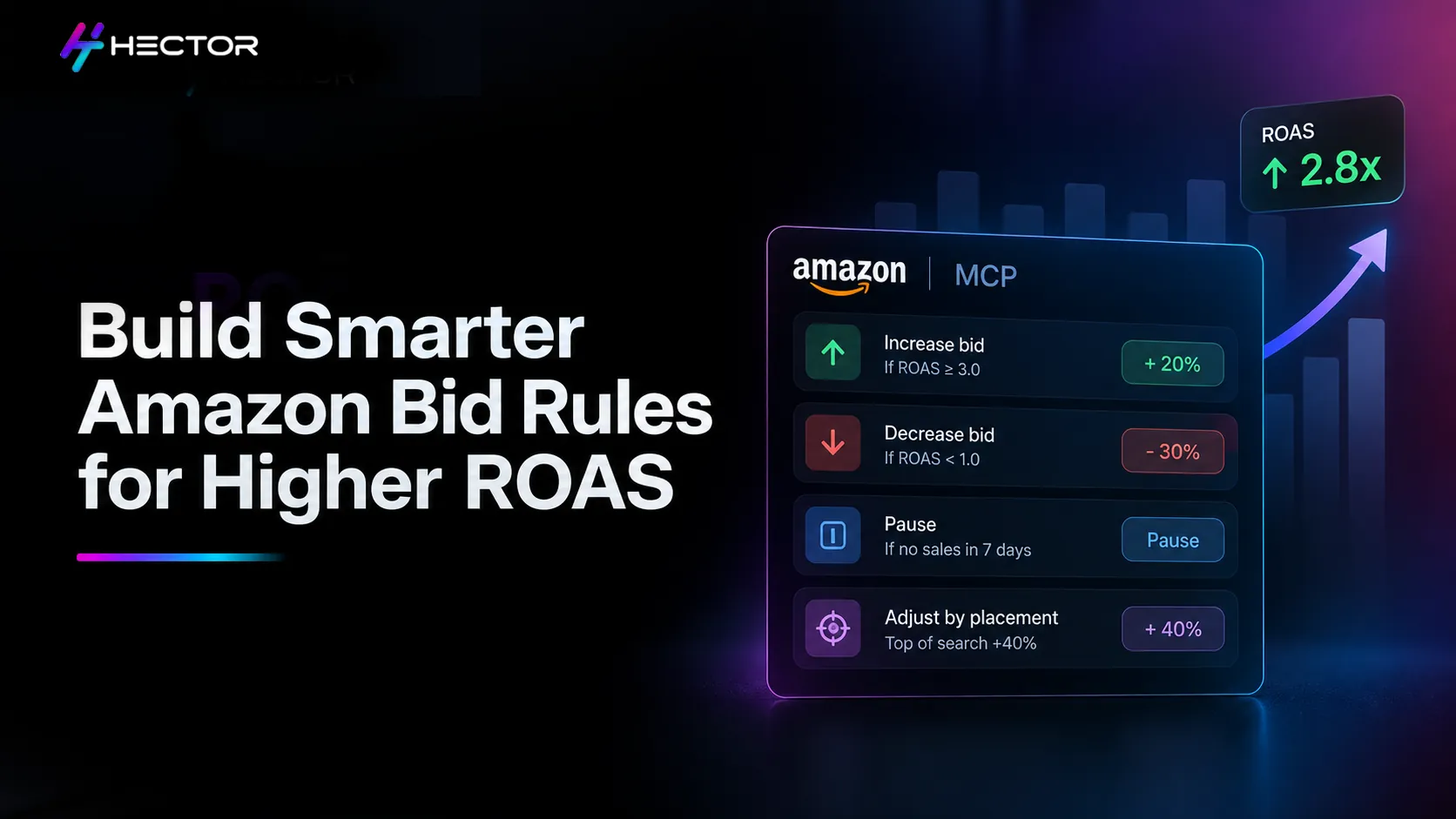
Amazon also offers rule-based bidding that automatically adjusts bids based on ROAS guardrails configured by the advertiser. It is also important to remember that a ROAS target is an optimisation objective, not a guaranteed outcome. There is no universal sequence where every campaign should start with Down Only, move to Up and Down after 30 days, and eventually graduate to Fixed Bids or ROAS-based bidding. A better framework is to start with the objective. Dynamic Down Only can be worth considering when you want Amazon to reduce bids for opportunities considered less likely to convert. This can be particularly useful when efficiency and spend control are priorities. For campaigns in a new marketplace, Amazon itself recommends considering Dynamic Down Only while learning what works and analysing initial performance. But there is no fixed number of days for which every campaign must remain on this strategy. Dynamic Up and Down can be useful when you are willing to give Amazon greater flexibility to compete for opportunities it predicts are more likely to convert. Amazon highlights use cases such as: Sales-focused campaigns High-performing campaigns Deal ASINs Products with excess inventory Campaigns where stronger placement competitiveness is desirable Monitor CPC, conversion rate, ACoS, ROAS, and placement performance to determine whether the additional bid flexibility is producing better business results. Fixed Bids can make sense when you want the bid you set to remain unchanged by Amazon's conversion-based dynamic bidding. This can provide greater predictability over your bidding inputs. However, Fixed Bids should not automatically be assigned to mature products, exact-match keywords, branded terms, or "hero keywords." Those campaigns may still perform better with dynamic bidding. The decision should come from performance data. Product maturity can provide context, but it should not dictate the bidding strategy by itself. For a new product, the immediate goal is often to generate visibility, clicks, search-term data, and initial conversions while keeping spend within acceptable limits. Dynamic Down Only can be considered when tighter spend control is important. Dynamic Up and Down may also be tested when sales growth and competitive visibility are higher priorities. Starting bids should be based on factors such as: Amazon's suggested bid range Expected conversion rate Product economics Break-even ACoS Campaign objective Category competition There is no universal rule that starting bids should be 70% or 80% of a target CPC. Once campaigns begin generating meaningful performance data, advertisers can make more informed bidding decisions. Look at: Conversion rate ACoS and ROAS CPC Placement performance Budget utilisation Keyword and product-target performance If Top of Search materially outperforms other placements, a placement bid adjustment may make sense. If Amazon's dynamic bidding is producing incremental conversions efficiently, Up and Down may deserve a larger role. The decision should follow performance rather than a fixed 30-day or 90-day milestone. Mature campaigns generally provide more data for making precise bid decisions. Some targets may benefit from Fixed Bids when tight bid control is important. Others may perform better with Dynamic Up and Down. ROAS-based rule bidding may also be relevant where the campaign is eligible and the advertiser has a clear ROAS objective. A mature account does not need one bidding strategy. Different campaigns can use different approaches based on their role in the account. The challenge changes as an account grows. Manually reviewing 20 targets is manageable. Reviewing hundreds or thousands of keywords and product targets across dozens of campaigns becomes much harder. Brands using Amazon Marketing Cloud can layer attribution and audience data on top of bidding performance to identify which campaigns and placements are driving the highest lifetime value customers. This is where automation can help. But it is important to distinguish between Amazon's native bid rules and third-party performance-based automation. Amazon provides capabilities such as: Dynamic bidding Placement bid adjustments Schedule-based bid rules Event-based bid rules ROAS-based rule bidding These capabilities operate within Amazon Ads. Third-party Amazon Ads platforms can add another automation layer. Platforms such as Hector Ai can apply this type of rule-based automation across Sponsored Ads campaigns, allowing advertisers to define their own optimisation logic and run it automatically at scale.Rule-Based Bidding With ROAS Guardrails
This is different from describing "Target ROAS" as a fourth standard bidding strategy.
ROAS-based rule bidding is an additional automation capability.Which Bidding Strategy Should You Use?
When You Want More Spend Control
When Sales Growth Is the Priority
When You Want Tighter Bid Control
A Better Product-Stage Framework
New Products
Growing Products
Mature Products
Moving From Manual Bid Management to Automation
Amazon Native Automation
Third-Party Rule-Based Automation
The exact metrics, schedules, lookback windows, safeguards, and actions depend on the automation platform being used.Three Bidding Mistakes to Avoid