

The first instinct is to panic. The second is to start typing a reply that begins with 'This is completely unfair...' Both of those responses will extend your suspension, not end it. Amazon does not want your frustration. It wants evidence that you understand what went wrong, have already fixed it, and have built a system to make sure it will not happen again. That document is called a Plan of Action, and writing a good one is the difference between being reinstated in 48 hours and being stuck in limbo for weeks. In 2026, the stakes are higher than they were even two years ago. More than a third of sellers earning between $100,000 and $1 million per month have experienced an account suspension (SmartScout, 2026). Amazon's enforcement is now AI-driven, faster, and has expanded into categories that did not exist before. This guide covers what actually works, including the changes you need to know for 2026. Think of a Plan of Action like a job application for the position of 'trusted Amazon seller.' You have been fired, or at least put on leave, and Amazon is reading your application to decide whether to bring you back. The reviewers are not looking for a story. They are looking for a demonstration that you took the problem seriously, fixed the root cause, and have something concrete in place so it does not happen again. Amazon reviewers read hundreds of appeals every day. Vague responses, emotional language, and generic templates are filtered out quickly. What gets through is a clear, structured, and specific document that answers three questions: what went wrong, what you did about it, and how you will prevent it from happening again. A POA is not optional. For any account or listing suspension, Amazon will require this specific format. Understanding the format before you start writing saves you from the most common trap: submitting a rushed appeal that gets rejected, which then resets the review queue and costs you more time than getting it right the first time would have. This is the step most sellers skip, and it is the step that determines whether your POA even has a chance. Amazon's enforcement in 2026 operates across three meaningfully different categories, and the document that works for one category will likely fail for another. These are the suspensions most sellers are familiar with: Order Defect Rate above 1%, late shipment rate too high, cancellation rate over the threshold, inauthentic product complaints, intellectual property claims, restricted item violations, review manipulation, or listing policy breaches. For these, the standard three-part POA format works. The enforcement is policy-specific: you violated a defined rule, Amazon has evidence of it, and your POA needs to address that specific rule and nothing else. Response timeline for a well-written first POA: 24–48 hours. Section 3 refers to the Business Solutions Agreement clause covering deceptive, fraudulent, or illegal conduct. It is Amazon's most serious suspension category, and it is growing. In 2026, Section 3 cases have increased substantially, and they are the ones with the lowest reinstatement rate. Section 3 suspensions can arise from: fraud allegations, counterfeit claims escalated to the fraud level, related-account violations, variation abuse treated as catalogue fraud, and business verification failures. They frequently require legal-grade documentation: not just invoices and SOPs, but evidence of business identity, chain of custody, and corporate separation in some cases. Amazon increasingly requests a video verification call as part of Section 3 reinstatement. Completing the video call is important, but it does not guarantee the suspension lifts. The documentation submitted alongside and after the call is what determines the outcome if you receive a Section 3 notice. Professional or legal help is strongly recommended before you submit anything. This is the category that most sellers do not know exists until it happens to them. Amazon's machine learning now flags accounts based on behavioural patterns: not just confirmed policy violations. It acts on risk signals and pattern matches before a human reviewer ever gets involved. Common AI trigger patterns in 2026 include: device fingerprint or IP address overlaps between accounts, shared virtual assistants who manage multiple seller accounts, invoices the AI flags as unverifiable under new supply chain security standards, discrepancies between your Amazon listing claims and what your external website says, and account links to suspended sellers through shared 3PLs, bank details, or business addresses. That last point is important. If your Shopify page makes a claim that your Amazon listing avoids: say, a health benefit you have removed from the listing but left on your website, Amazon's AI treats the website as the honest version and flags the ASIN. The violation technically lives outside Amazon's platform, which is why sellers are surprised by it. If your suspension notice is vague, mentions 'related account concerns,' or cites 'account integrity,' treat it as a potential AI-detection case and approach it accordingly. This is where most appeals fail: not because sellers lie, but because they are not specific enough. Amazon's reviewers reject root causes that are vague or generic, regardless of how honestly they are written. Think of it like a doctor's note. If your note says 'patient was unwell,' it conveys nothing useful to the next doctor who reads it. If it says 'patient presented with a 38.5-degree fever and a confirmed bacterial throat infection requiring a five-day course of amoxicillin,' the doctor knows exactly what happened and can continue the treatment. Amazon needs the advertising equivalent of that second note. A good root cause identifies the specific ASIN, the specific date, and the specific process gap. A correct root cause sounds like: "On August 14, 2026, three A-to-Z claims were filed against ASIN B0XXXXXX for items arriving damaged. The root cause was a failure in our packaging QC process: we had switched to a new packaging supplier in July without updating our pre-shipment inspection checklist for fragile items." A rejected root cause sounds like: "We always prioritise customer satisfaction and were not aware this was happening." That sentence takes responsibility for nothing. Amazon's reviewers have seen it thousands of times. Name the ASIN, the date, and the specific policy or metric that was breached. Identify the precise process failure: not a general shortcoming. Take ownership without blaming customers, suppliers, or Amazon. Every corrective action must be written in the past tense. Amazon is not interested in what you plan to do: it wants to know what you have already done. Future promises with no evidence of completion are one of the primary reasons appeals get rejected in 2026. Corrective actions should be concrete and specific: not 'we will improve our supplier relationships' but 'we terminated the contract with Supplier X on August 15, 2026, and signed a replacement supplier agreement with verified documentation on August 18, 2026, prior to submitting this appeal.' Issued refunds or replacements to all affected customers (with dates). Removed unverified inventory from fulfilment centres. Retested or re-inspected affected products with third-party verification. Terminated or paused relationships with the supplier or logistics partner that failed. Pulled down or corrected any external listings, website claims, or social content that conflicted with Amazon policy. Preventive measures are your promise to Amazon that the process gap you identified in the root cause cannot occur again. Think of it like adding a smoke alarm after a kitchen fire: not because the fire will definitely happen again, but because you have accepted that your previous system had a gap and you have closed it. Each preventive measure should directly correspond to the root cause you identified. If your root cause was a packaging inspection gap, your preventive measure is a new inspection checklist for packaging changes. If your root cause was a listing claim that conflicted with your website, your preventive measure is a cross-platform content review process that runs before any listing or website change goes live. New SOPs or checklists for the specific process that failed. Regular account health monitoring schedule (daily or weekly). Supplier verification steps now required before any new inventory enters the fulfilment pipeline. Staff training records on the specific policy that was violated. Automated alerts for key performance metrics before they breach Amazon's thresholds. The submission path matters. Log in to Seller Central and navigate to: Performance > Account Health > Reactivate Your Account. This is the correct channel. Submitting through a different route can delay the review or send your appeal to the wrong queue. Submit once. Do not send multiple appeals simultaneously: each new submission replaces the previous one and resets your queue position. If your first appeal is rejected, read Amazon's response carefully, identify what was missing or weak, revise the POA specifically to address that gap, and resubmit a stronger version. Documentation does not replace the POA: it supports it. Only attach what is directly relevant to the specific issue in the suspension notice. An appeal buried in irrelevant files makes the reviewer's job harder, not easier, and can slow your case down. For straightforward performance suspensions with a well-constructed first POA, Amazon typically responds within 24–48 hours with one of three outcomes: reinstatement approved, additional information requested, or appeal denied. If denied, re-read Amazon's response carefully: the problem usually lies in a weak root cause, insufficient evidence for the corrective steps, or preventive measures that sound too vague to be credible. Section 3 cases operate on a different timeline entirely. These frequently require multiple documentation rounds before Amazon restores selling privileges, and a video verification call may extend the process further. Do not assume a rejection means the case is closed: it typically means Amazon needs more specific evidence, not a different argument. When an Amazon account is deactivated, funds in your account balance are held for a 90-day settlement period. This period covers potential customer refunds, chargebacks, and A-to-Z claims that may still arrive after the suspension date. Only after 90 days can you request disbursement of any remaining balance. This has a real cash-flow consequence for most sellers. If you are suspended, understanding the 90-day timeline changes how you approach the appeal: acting fast is not just about reinstating the business, it is about preserving the working capital you need to operate while the appeal is pending. Act within seven days. Submit your POA within seven days of receiving the suspension notice. The 90-day fund hold is counting from the deactivation date, and delays reduce your window for a clean reinstatement. Quote Amazon's policy text directly. Reference the specific policy you violated by name, where possible: 'as per Amazon's Product Authenticity Policy' or 'in accordance with Amazon's Late Shipment Policy.' This demonstrates you have read and understood the rules. Keep it under one page. Use bullet points for the three sections and keep the whole document to one well-formatted page. Reviewers skim dozens of appeals per hour: a long POA buries the information they are looking for. Think from Amazon's perspective. Ask yourself: 'If I were an Amazon reviewer reading this, would I be confident that this seller has fixed the problem and it will not happen again?' If the answer is uncertain, the POA needs more work. For Section 3 cases, get professional help before submitting anything. Each failed appeal attempt narrows your chances. A complex case handled incorrectly from the start is significantly harder to recover than one where the first submission was right. Align your external presence with your listing. Before submitting any POA in 2026, check that your website, social media pages, and Amazon listings make identical claims. Amazon's AI now cross-references all three, and a discrepancy outside the platform can trigger or extend a suspension.
You wake up to an email from Amazon. Your account is suspended. Every active listing: gone. Every pending order: frozen. And the revenue your business depends on has paused until further notice.What an Amazon Plan of Action Actually Is
Know Your Suspension Type Before Writing a Single Word
Standard Performance or Policy Suspensions
Section 3 Suspensions: A Different Beast Entirely
AI-Detected Risk Signals: The Newest Suspension Category
The Three-Part Structure Amazon Expects in Every POA
Part 1: Root Cause: What Happened and Why
Part 2: Corrective Actions: What You Have Already Done
Part 3: Preventive Measures: How You Will Stop It from Happening Again
How to Submit Your POA in Seller Central
The 2026 Amazon Plan of Action Template
Supporting Documentation That Strengthens Your Appeal
Sellers managing larger accounts with historical performance data can also reference consistent account health metrics prior to the specific incident to demonstrate that the issue was an isolated deviation rather than a systemic problem. Platforms like Hector AI maintain this account health and campaign performance data at the campaign level, which can provide a credible before-and-after reference when building the evidence package for a complex appeal.What Happens After You Submit
Standard Timeline
The 90-Day Fund Hold: What Sellers Don't Know Until It's Too Late
Mistakes That Get Appeals Rejected Every Time
Expert Tips for a Stronger POA
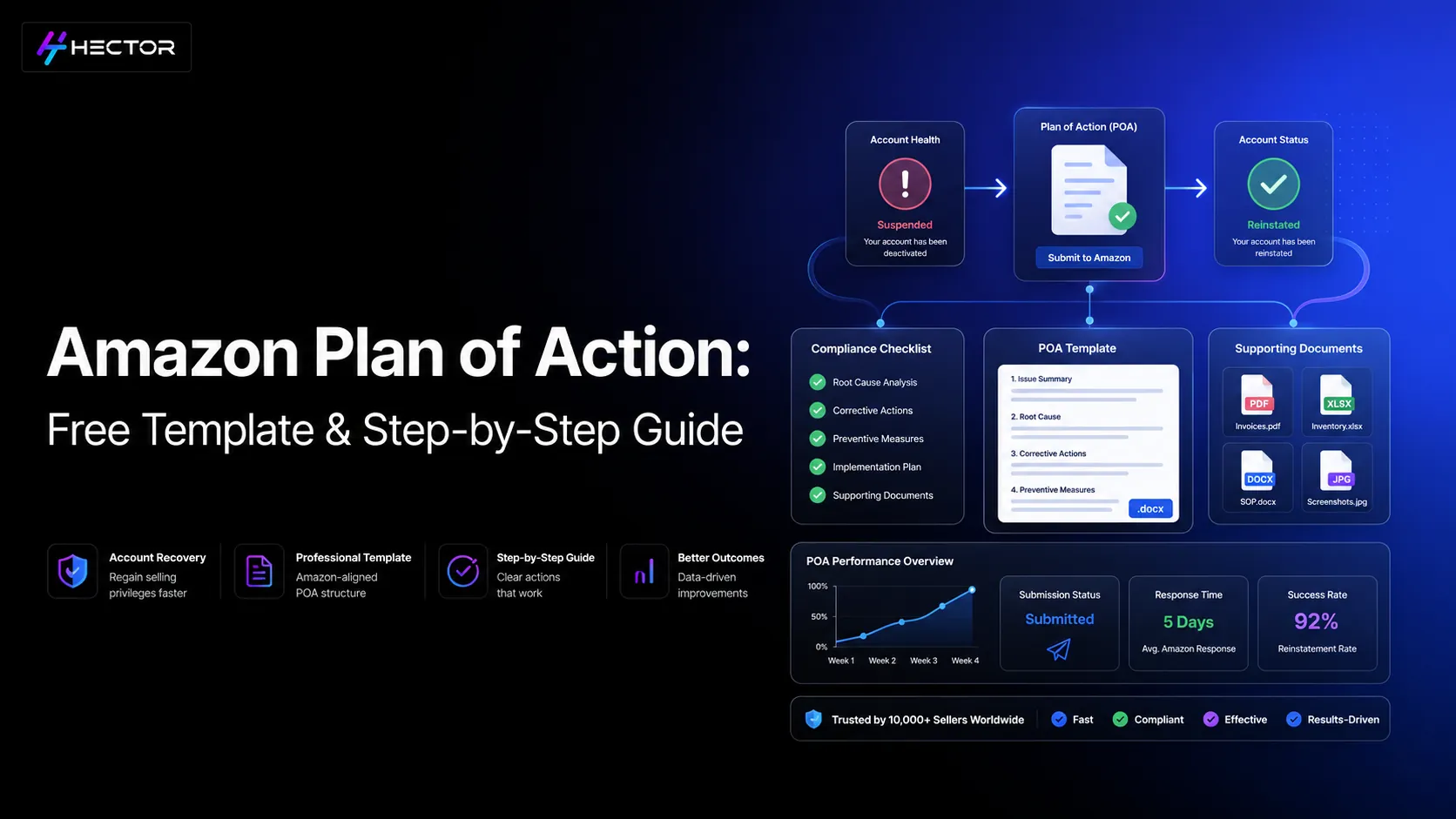
Amazon Plan of Action 2026: Free Template and Step-by-Step Guide
Frequently Asked Question
A Plan of Action is the formal reinstatement document you submit through Seller Central after receiving a suspension notice. It follows a three-part structure: Root Cause (what went wrong and why), Corrective Actions (what you have already done to fix it), and Preventive Measures (the systems you have implemented to stop it from happening again). It is a business case for reinstatement, not an apology letter.
Section 3 refers to the Business Solutions Agreement clause covering deceptive, fraudulent, or illegal conduct. Unlike a standard performance suspension, Section 3 cases involve allegations of serious misconduct and require legal-grade evidence, often including a video verification call with Amazon's enforcement team. They carry the lowest reinstatement rate of any suspension type and frequently require professional or legal help to navigate successfully.
Any time Amazon suspends your account or deactivates a listing due to a policy violation, performance issue, authenticity complaint, intellectual property claim, or account integrity concern. In 2026, this now includes AI-detected risk signals, related-account flags, and variation or catalogue abuse cases: all of which have their own nuances in terms of what evidence and structure the POA needs.
For straightforward performance or policy suspensions with a strong first POA, expect a response within 24–72 hours. Section 3 cases can take weeks and often involve multiple documentation rounds. If your first appeal is denied, revise and resubmit with more specific evidence: do not submit multiple appeals simultaneously, as this resets your queue position rather than accelerating the review.
Funds in your account balance are held for a 90-day settlement period following deactivation. During this time, the balance covers any outstanding customer refunds, chargebacks, and A-to-Z claims. After 90 days, you can request disbursement of the remaining balance. This is why acting on your appeal quickly matters: the 90-day clock starts at deactivation, not at your submission date.
No. Opening a new seller account after a suspension is classified as a related-account violation and will typically result in that new account being suspended as well. Amazon's systems track device fingerprints, IP addresses, bank account details, and other identifiers across accounts. The only recommended path is to appeal and reinstate the original account.