

There is more to running ads on Amazon than simply investing in keywords and hoping for sales. Knowing when to go wide to capture discovery and when to focus on customers who are ready to buy is essential for success. Amazon PPC match types are useful in this situation.
The differences between broad, phrase, and exact match keywords in Amazon PPC will be discussed in this article, along with how each affects visibility and ad spend and how to strategically combine them for maximum return on investment (ROI).
By the end of this article, you will understand precisely when to utilize Amazon phrase match, when to use broad match to start the funnel, and when to use exact match targeting to get laser-focused.
What Are Amazon PPC Match Types?
When you start a Sponsored Brands or Sponsored Products campaign, Amazon asks you to select a type of keyword match. This option regulates how closely your keyword must appear in a customer's search query before your ad is displayed.
Consider it a kind of filter:
The widest net is cast by Broad Match.
Phrase Match strikes a balance between reach and relevancy.
Precision targeting is provided by Exact Match.
Selecting the appropriate Amazon keyword match type has a direct effect on ACOS (Advertising Cost of Sales) and visibility. Misusing them will waste money without generating significant conversions, thus it's like pouring water into a leaky bucket.
Amazon Broad Match: Maximum Reach, Minimum Control
When a customer searches for your keyword, synonyms, similar terms, or even misspellings, your ad will show up, thanks to Amazon broad match. For instance, your ad may appear for searches for "Bluetooth earbuds" or "noise-canceling headsets" if your keyword is "wireless headphones."
Pros:
Great way to discover new search keywords that convert well.
Broadens the scope of your audience beyond simple inquiries.
Cons:
More likely to click on unrelated content.
Might worsen ACOS if left unchecked.
Pro Tip: In order to block irrelevant traffic, broad match campaigns should always be paired with negative keywords. In order to regulate reach, test relevance, and reduce waste, Amazon uses a broad phrase exact technique that combines all three match types.
Amazon Phrase Match: The Sweet Spot of Relevance
Although it may contain terms before or after, Amazon phrase match makes sure your ad only appears when a customer's query contains your keyword phrase in the precise order.
The term "wireless headphones," for instance, might result in advertisements for "the best wireless headphones under $100" or "wireless headphones for the gym," but not for "Bluetooth earbuds."
Pros:
Excellent balance between relevance and discovery.
Higher conversion rates compared to broad match.
Cons:
Continues to allow some pointless traffic.
Is unable to recognize potential changes outside of the phrase order.
Sellers frequently refer to Amazon PPC phrase match as the "workhorse" of keyword targeting. It maintains ACOS more steadily than broad match while capturing a large but relevant net of searches.
Amazon Exact Match: Laser-Focused Conversions
Your ad will only appear if the customer's query contains your keyword exactly (or with close variants like plurals and misspellings) when you use exact match.
If your keyword is "wireless headphones," for instance, your ad will only appear for that term or extremely similar variations.
Pros:
Best conversion rates and the highest level of relevancy.
Reduces the amount of money wasted on pointless clicks.
Cons:
Very limited reach.
Requires strong keyword research.
For high-intent, purchase-ready terms, exact match performs best. It's perfect if you want to double down on winners after testing terms with broad or phrase matches.
How to Use Amazon Keyword Match Types Together
The most successful ads intentionally incorporate different match types rather than selecting just one:
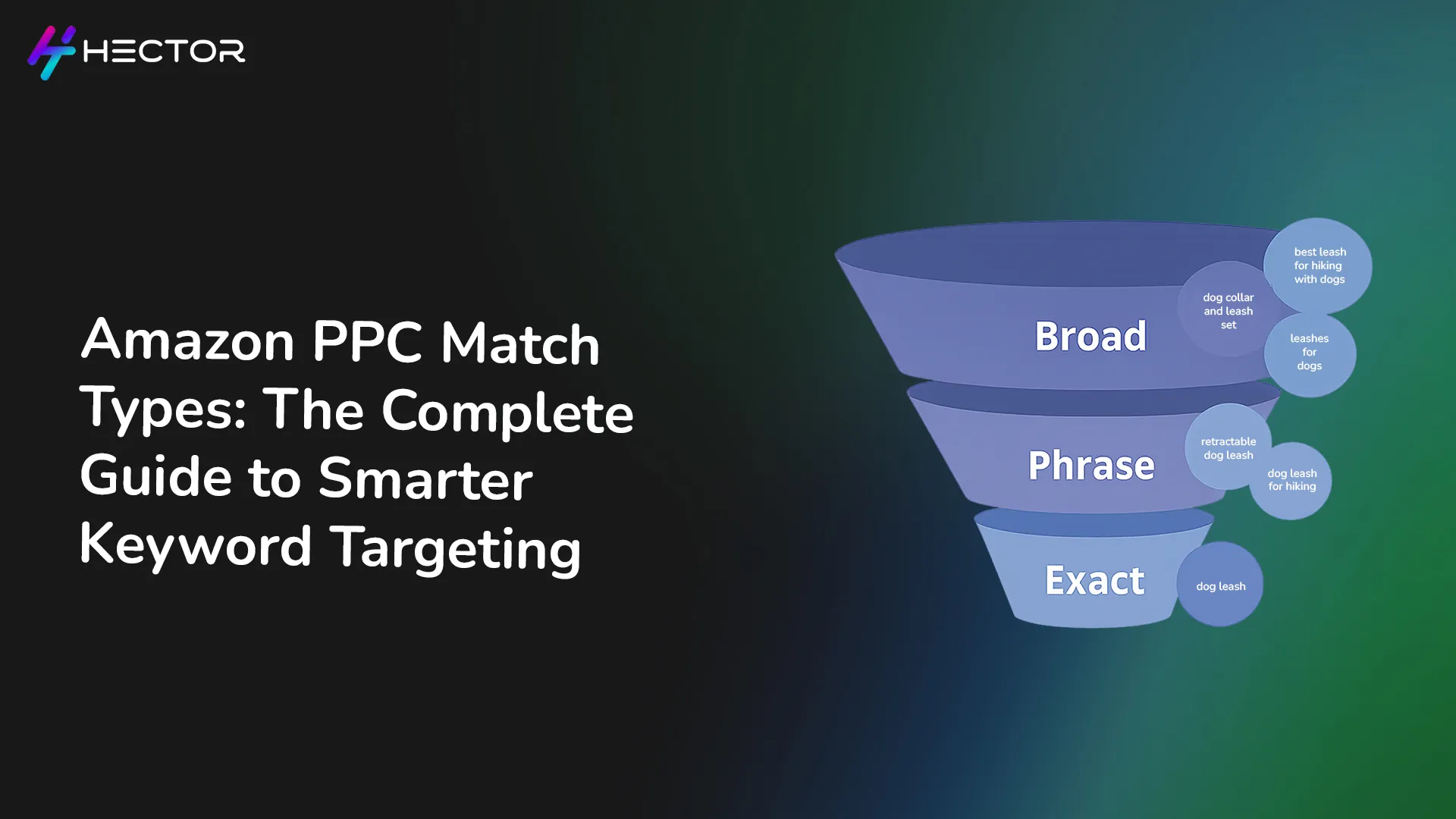
Start broad to discover potential keywords.
Move to phrase match to refine and filter the highest-performing search queries.
Shift top performers into exact match for maximum ROI.
With broad discovery at the top, targeted refinement in the center, and high-converting exact match at the bottom, this Amazon broad phrase exact structure creates a keyword funnel.
Hector Insight: Smarter Match-Type Optimization
Especially when dealing with hundreds of ASINs, manually adjusting Amazon PPC match types can be very difficult. Hector can be useful in this situation. Hector finds high-ROI keywords by analyzing search term reports and, via rule-based automation, converts them from wide to phrase to specific. To reduce wasted ad spend, it also instantly adds negative keywords.
Understanding Amazon keyword match types is essential if you want to avoid wasting money on ads and create a successful, scalable campaign. For discovery, use broad match. For balance, rely on phrase match. For accuracy, double down with an exact match.